Back Rank Checkmate
Checkmates are always satisfying, however few are as satisfying as the back rank checkmate. It can be sudden, you can appear to have control over the board and next minute a queen or rook reaches the back rank and the gamer is over. While satisfying it is also highly common, it doesn't need to be highly complicated. Usually the conditions have already been created by the losing player for the checkmate to work. It can be as simple as a trapped king, an active rook and a few unmoved pawns. And so learning and understanding the back rank mate is a highly useful skill and a needed tactical lesson to improve in chess.
What Is Back Rank Mate in Chess?
The Back Rank Mate is when a trapped king is located on its home rank and is checkmated by either a queen or rook. The king isn't able to escape the checkmate as its own pawns are blocking the key escape square. Usually the pawns are positioned on their starting squares in front of the trapped king.
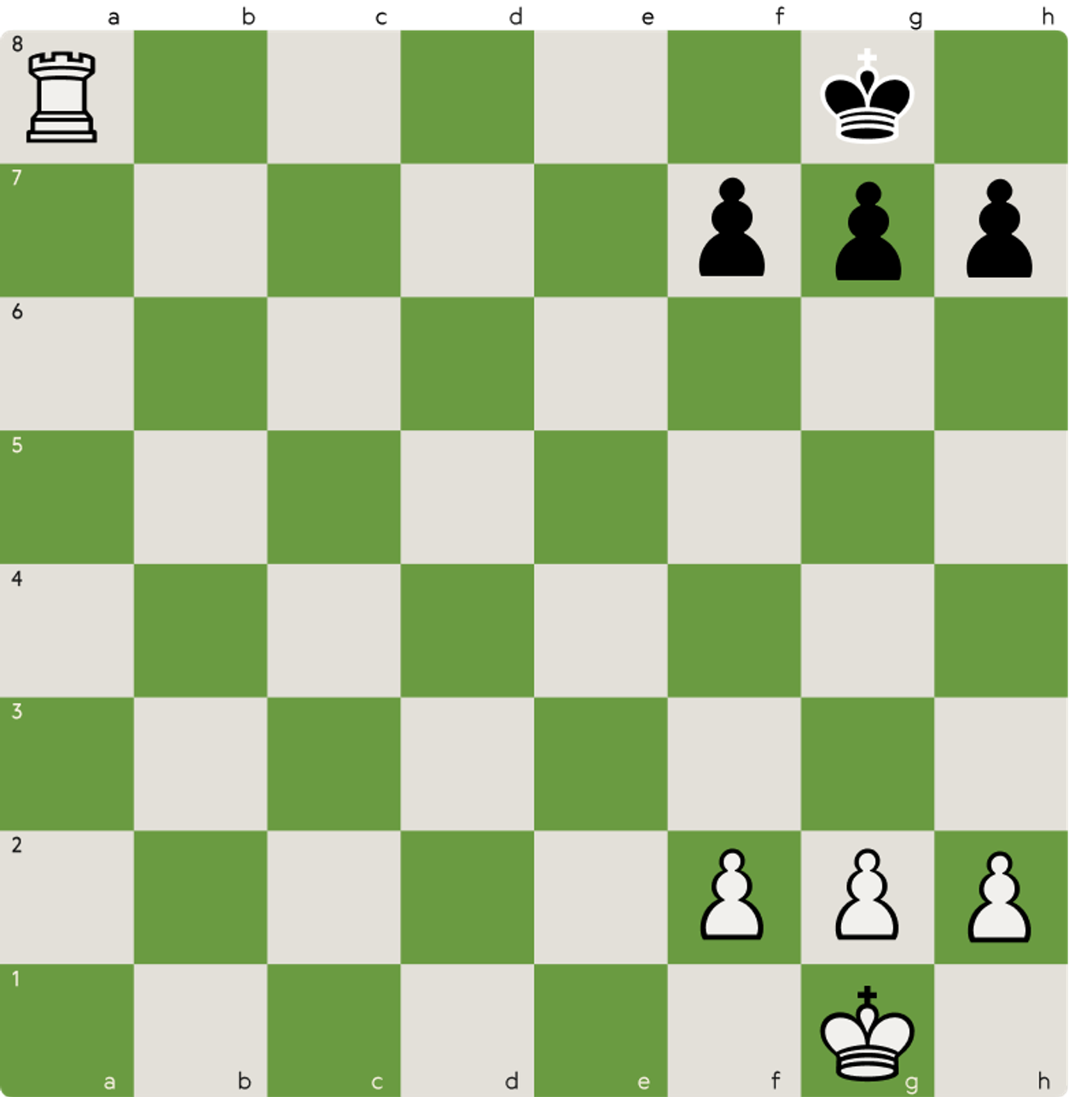
For example, a king is located on g8, accompanied by pawns on f7, g7, and h7. Then the enemy rook or queen reaches the back rank to deliver the check, leaving the king with nowhere to run to.
This makes up the basic concept of back rank mate in chess. The active attacking piece controls the rank and the king is confined by their ally pieces.
Characteristics:
- A king stuck on the first or eighth rank
- Pawns blocking escape squares
- An attacking rook or queen
- Limited defensive material
Experienced players can also overlook these well known patterns when only focusing on threats.
How Does A Back Rank Mate Happen
A back rank mate doesn't just appear though, normally there are several moves that lead up to the mate occurring. Neglecting the king's safety tends to be the most common cause to contribute to the mate. Kingside pawns can be left untouched for long stretches of time. While harmless in some cases, it comes along with its own weakness.
A positional example:
- Black castle is kingside.
- Pawns are located on f7, g7, and h7.
- White controls an open file.
- The rook invades the eighth rank.
As soon as the white rook is able to get to the back rank the game can be over. Heavy-trade pieces can also be a common scenario. Sometimes when a lot of material is taken a player forgets about tactical threats. But even a simple rook can easily deliver a back rank mate if the king is trapped.
This is why strong players often create "luft" for their king. Luft is a German word meaning "air" and refers to giving the king an escape square by advancing a pawn.
Back Rank Mate Chess example
Classic example:
White pieces:
- King on g1
- Rook on e1
Black pieces:
- King on g8
- Pawns on f7, g7, h7
If White controls the e-file:
Re8+
Black's king cannot move to:
- f8
- g7
- h7
The king is confined, the rook delivers a checkmate. It may appear simple at first but there are many variations that can appear regularly. Once you are able to identify the pattern irl you shall be able to notice back rank mate opportunities far more often.
How To Avoid A Back Rank Checkmate
Fortunately, defending this tactic tends to be easier than executing.
The most common defensive method would be to give the king an escape square.
As an examples:
- h3 or h6
- g3 or g6
- f3 or f6
A single pawn move can prevent many back-rank disasters.
Other useful defensive habits include:
- Watching open files carefully
- Keeping rooks active
- Avoiding passive piece placement
- Checking for tactical threats before trading pieces
When reviewing games, make sure you can identify moments where your king became trapped behind pawns. Often, the warning signs appear long before the actual checkmate.
Chess Back Rank Importance
The value of studying Back Rank Mate in chess extends beyond learning a single mating pattern.
This tactic teaches several important lessons:
- King safety matters throughout the game.
- Small pawn moves can prevent major problems.
- Open files are dangerous.
- Active rooks can become powerful attacking pieces.
Many tactical combinations eventually lead to a back-rank theme. Players may sacrifice material, force exchanges, or open files specifically to create this opportunity.
Understanding Back Rank Mate also improves defensive awareness. As soon as you know the patterns, you become much better at seeing the danger before it becomes unavoidable.
If you liked this you may also like:
- Double Attack
- Hanging Pieces
Conclusion
The Back Rank Mate is one of the first checkmating patterns every chess player should learn. It appears frequently, is easy to recognize once understood, and teaches valuable lessons about king safety and piece activity.
Although the final checkmate often looks dramatic, the real mistake usually happens much earlier. A king without an escape square can become vulnerable for many moves before the decisive blow arrives.
By learning to recognize Back Rank Mate opportunities and by creating a simple escape square when necessary, players can both win more games and avoid some painful losses.
See Also
Read more: Checkmate, Smothered mate, and Rook in Chess.