Chess Greek Gift Sacrifice
Most tactical patterns in chess come and go during a game without leaving much of an impression. The Greek Gift is different. Players remember the first time they see it work properly. One move looks strange, almost reckless, and then suddenly the defending king has nowhere safe to stand. A bishop disappears on h7 or h2, pieces flood toward the king, and the game starts feeling impossible to defend. What makes the idea interesting is that the sacrifice itself is usually not complicated. The difficult part is understanding when it actually works. A lot of beginners try the attack too early because the pattern looks dramatic. Experienced players are usually more careful. They monitor the activity of the pieces and the safety of the king. It is a careful balance of calculation and aggression, hence why this tactic has been and remains popular for decades
What Is a Greek Gift in Chess?
The Greek Gift is a bishop's sacrifice played against a castled king. In most examples, White sacrifices a bishop on h7. Black can perform the same idea on h2.
The move often starts with:
Bxh7+
If the bishop is captured by the pawn, the side who is attacking moves to a check to bring the knight and queen.
The aim is to move the king away from his defense and then attack before he is defended again.
In many classic examples, the knight jumps to g5 immediately after the sacrifice. The queen then enters through h5 or another attacking square, creating threats around the exposed king.
This tactical pattern is commonly called a chess greek sacrifice because material is intentionally given up to create attacking momentum.
The bishop is normally the sacrificed piece because it can attack h7 or h2 directly from the diagonal.
Example of the Greek Gift
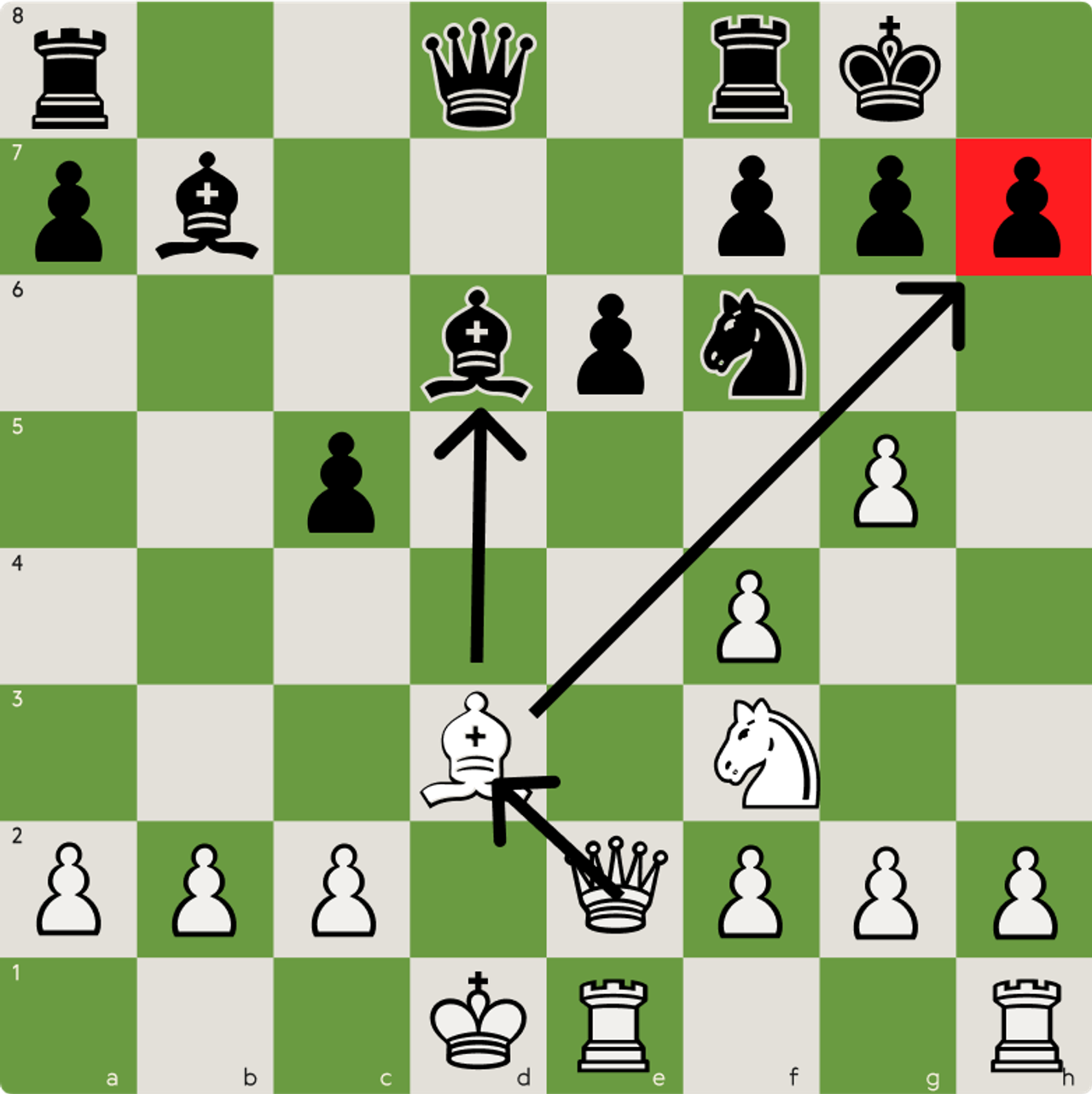
One detail appears in many successful examples of the greek gift: the defending king becomes separated from the rest of the pieces very quickly.
Greek Gift Sacrifice Requirements
A bishop sacrifice on h7 does not automatically mean the attack is winning.
Sometimes the defending side simply accepts the piece, returns material later, and survives comfortably. That is why strong players usually evaluate the surrounding position before committing to the sacrifice.
Several positional details often matter:
- The attacking knight can reach g5 quickly
- The queen has a path toward the kingside
- The defending knight cannot easily return to f6 or g6
- The center is relatively closed
- The defending king has limited escape squares
A common continuation might look like this:
Bxh7+ Kxh7
Ng5+ Kg8
Qh5
At this point, threats against h7 or mating attacks along the h-file can become dangerous.
One important thing newer players eventually learn is that timing matters more than memorization. The same sacrifice can be brilliant in one position and completely losing in another.
That is part of what makes chess greek gift positions interesting to study.
Typical Warning Signs for the Defender
- Few pieces protecting the king
- Weak dark squares near the king
- Passive defending pieces
- No easy counterplay in the center
- Limited mobility around h7 or h2
When several of these problems appear together, the greek gift becomes much more realistic.
Greek Gift Etymology
The origins of the name most likely derive from the old expression “Beware of Greeks bearing gifts.” Originating from the Greek mythological story the Trojan Horse. In the story, the horse first appears as a harmless gift but once trust is lent it leads to disaster. The comparisons exist because the sacrifice works in a similar way.
Chess players adopted the comparison because the sacrifice works in a very similar way.
At first, the bishop looks free.
Then the king steps forward, attacking pieces arrive, and the position suddenly becomes difficult to hold together. It is unclear when the naming occurred however it appears referred to as such in chess books and games in the twentieth century.
It stayed popular partly because players immediately understood the metaphor.
Coordinated Attacking Pieces
Successful attacks usually involve cooperation between the queen, knight, and bishop rather than the sacrifice alone.
Importance of Chess Greek Gift
The Greek Gift still appears regularly in club games because many players castle automatically without checking how safe the kingside actually is.
Studying the tactic teaches several useful attacking ideas at the same time.
For example:
- Active pieces often matter more than material
- King safety can collapse surprisingly fast
- Piece coordination decides many attacks
- Sacrifices only work when follow-up moves exist
The pattern also helps players improve calculation skills. Unlike simple one-move tactics, the attack usually requires visualizing several forcing moves in advance.
That is one reason coaches still use the pattern when teaching attacking chess.
Another useful lesson comes from defense. After a while of studying you are able to easily identify dangerous attacks before you have to sacrifice material.
Many players who study attacking chess later connect the pattern to other tactical ideas such as rook lifts, mating nets, and discovered attacks.
You can explore more tactical concepts and chess terminology on urlWorld Chesshttps://worldchess.com.
Conclusion
The Greek Gift is one of the best-known attacking sacrifices in chess for a reason. The idea is direct, memorable, and dangerous when the position supports it. Even though the sacrifice of the bishop is the most eye-catching, the true strength lies in the remaining pieces' coordination.
Learning how these attacks work increases tactical awareness, knowing when / when not to attack and evaluating your king’s safety. This is useful for all players, even ones who are more a fan of quieter positions. Players should be able to recognize threats as well as create them.
See Also
Read more: Tactics in Chess, Gambit in Chess, and The Opera Game.