King's Gambit
The king's gambit is a highly popular and one of the oldest openings in chess history. A pawn is sacrificed by white in the beginning of the game, with the aim of speed, activity, and direct pressure against Black’s king. Hence why it attracts players who enjoy sharp positions. The king's gambit opening asks questions immediately with white opening up lines, developing quickly and forcing tactical territory before either side has castled. It can be great for those aim for initiative, for others who prefer calm manoeuvring it can feel reckless, however either way it has become a well renowned opening.
How to Play King's Gambit
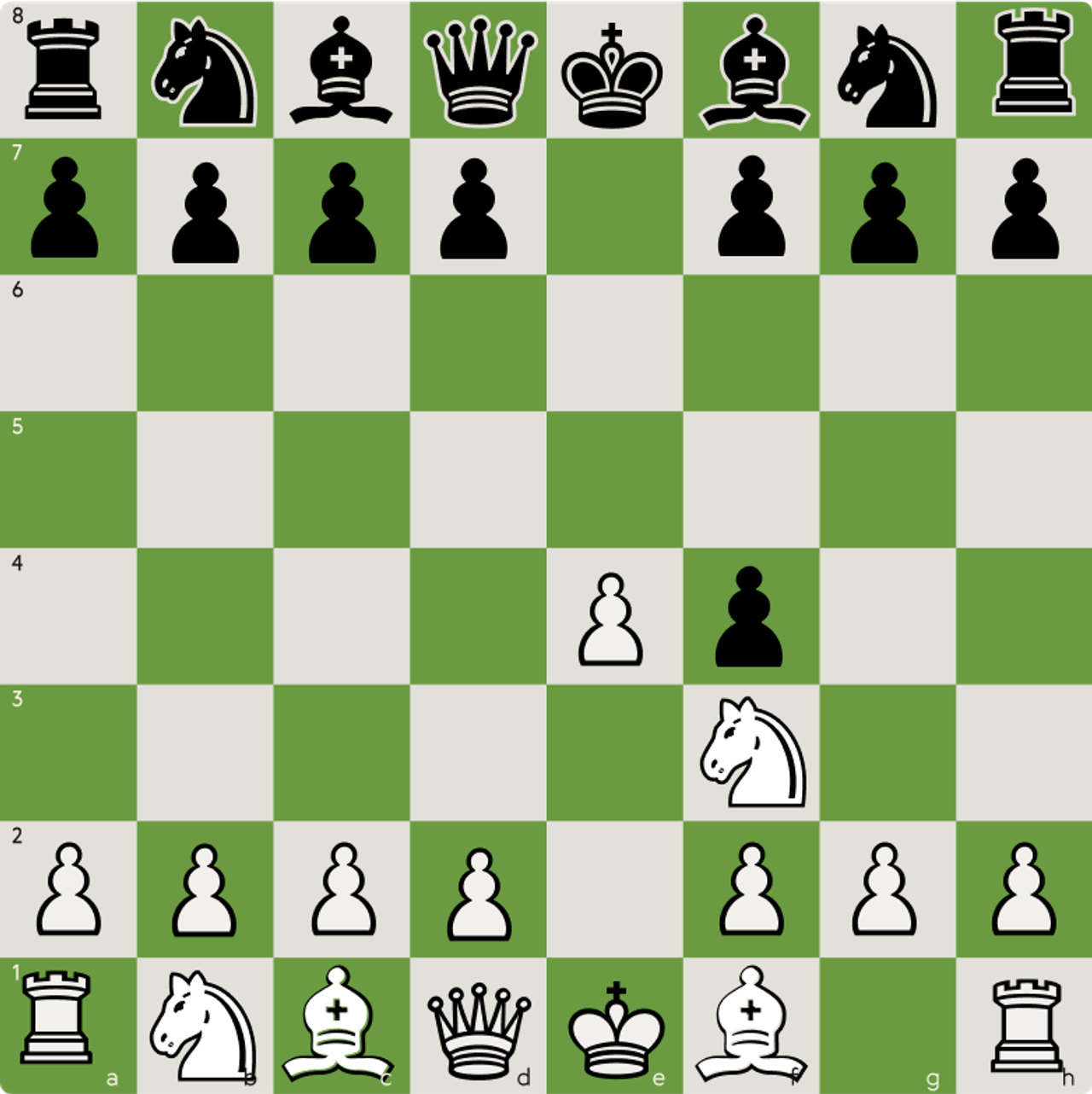
1.e4 e5 2.f4. Are the basic moves. White gives up the f-pawn to distract Black’s e-pawn and open the f-file. If the sacrifice is accepted by black, the game usually develops quite quickly after that
The core ideas behind the opening:
- open lines for the queen and bishop
- gain time by attacking the centre
- create chances for a quick kingside attack
- make Black spend time deciding how to respond
A common point for beginners is that White is not just “sacrificing a pawn.” The f4 pawn is offered to quicken development and decrease the safety of the Black’s king. In the king's gambit, the aim is not to maintain the pawn forever, but to use the opening it creates.
A few typical plans for White include:
- Nf3 to develop and pressure e5
- Bc4 to aim at f7
- castling quickly
- using the f-file if Black accepts the gambit
If you’d like to read more here are similar articles, Queen's Gambit and London System are useful companion topics.
King's Gambit Variations
The opening can differ depending on Black’s response.
Some king's gambit variations are:
| Variation | Main idea | Typical feel |
| Accepted | Black takes the pawn on f4 | Open, tactical, forcing |
| Declined | Black does not take the pawn | Slower, more positional |
| Bishop’s Gambit | White develops the bishop quickly | Aggressive and direct |
| Falkbeer Countergambit | Black fights back in the centre | Sharp and counterattacking |
| Modern Defence setups | Black keeps the position flexible | Less forcing, still tense |
The most famous branch is the Accepted line. Black captures the pawn and White attempts to prove that activity is worth more than material.
The Declined lines are often quieter, but “quiet” in this opening still means something different from most others. The position can become unbalanced very quickly if White is not careful.
Counterplays for King's Gambit
Black has several reliable ways to meet the gambit.
The most common counterplays include:
- accepting the pawn and trying to hold it
- declining the gambit and returning the game to calmer territory
- striking in the centre with ...d5 or ...exf4 followed by ...d5
- developing quickly and avoiding passive piece placement
The most important idea for Black is not to panic. White wants the game to become sharp, so Black should think carefully before opening too many lines too soon.
If the centre is handled correctly, the gambit often becomes much easier to meet.
A good habit for Black is to finish development before trying to win the extra pawn. For many kings' gambit positions, the player who develops with their king in a safer position is the one who will come out ahead. Even if the material may say something different.
King's Gambit History
There is a long and vast history to the king's gambit. It became very popular in the 19th century, when romantic attacking chess was at a height. A sacrifice makes sense to players when it leads to an attack.
After a while, defensive technique improved and so the common use of the king's gambit died down, but it never vanished. It can be utilized as a surprise weapon by strong players, especially in rapid or blitz formats where there are fast time controls.
The long history of the kings gambit adds to the special feeling it still carries today. It has old school energy while still being a solid foundational skill. It is certainly not one that should be left behind as it remains a serious weapon in the right hands.
Conclusion on King's Gambit
It is a highly daring opening, the sacrifice of a pawn to gain momentum and opening lines, leaving black feeling under pressure right at the start of the game. While not exactly safe that adds to the attraction for some players. If initiative, tactical chances, and forcing decisions floats your boat the king's gambit is a great fit. Or it is at least worth studying as it teaches you so much about attacking and development.
For those who wish to expand their repertoire, look no further than this gambit, no matter if it is for practical or theoretical use.