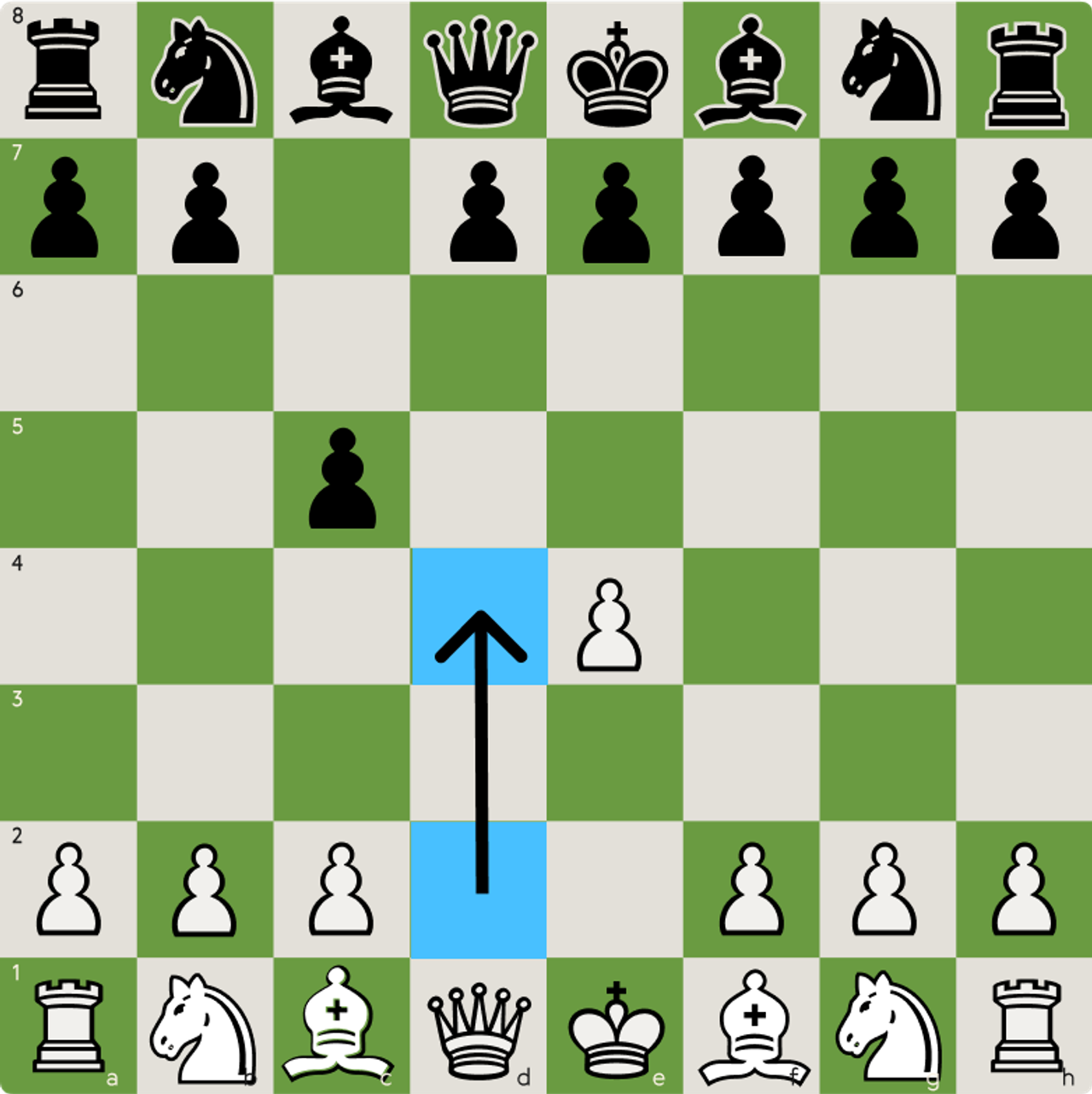
Sicilian Defense
One of the most famous replies to 1.e4 is the Sicilian Defense. It can create an unbalanced position and strategic choices for Black. Instead of mirroring White’s center immediately, Black strikes from the side with 1...c5 and invites a fight that often becomes very concrete very quickly. This can be the appeal for many, it doesn't give the promise of ease but counterplay. Black frequently gain active play, open lines and the opportunity to claim central squares. Hence why the opening is favored by many from the elite to the casual club level.
How to Play Sicilian Defense
The moves are simple: 1.e4 c5. There is no mirroring of white from black, with white’s pawn located on 1…e5. But black attacks d4 achieving an asymmetrical position.
A typical Sicilian opening plan:
- developing the knight to c6 or d7
- supporting ...d6 or ...e6
- preparing counterplay on the queenside
- challenging White’s center with ...d5 or piece pressure
The logic behind the opening is practical. More central space is gained by white, however black gains dynamic chances. For many Sicilian openings the side that is able to clearly understand the pawn breaks and activity is able to control the board more effectively.
Sicilian Defense Variants
There are numerous branches of the opening, contributing to its popularity.
Most-known systems are:
- Najdorf Variation – one of the sharpest and most respected lines
- Dragon Variation – famous for tactical chaos and opposite-side castling
- Classical Sicilian – a more flexible, strategic approach
- Accelerated Dragon – a quicker fianchetto setup
- Sveshnikov – highly theoretical and rich in counterplay
Each variation changes the character of the game. Some lead to wild attacks on both kings. Others create quieter but deeply strategic positions.
Black can choose the style that fits them. No matter if you favour initiative, solidity or long-term pressure, it is up to you. That's where the beauty lies.
A simple comparison:
| Variation | Style | Typical feature |
| Najdorf | Sharp | Rich tactical play |
| Dragon | Aggressive | Kingside attack chances |
| Classical | Flexible | Balanced development |
| Sveshnikov | Theoretical | Active central struggle |
History of Sicilian Defense
Existing for centuries, but the name grew in popularity in the 19th century. It has evolved from a less known opening into one of the most important in modern chess.
Its growth in popularity has assisted players who wanted to achieve more equal positions. Giving black practical winning chances, which makes it attractive to ambitious competitors. It was adopted by some of the strongest players, expanding their opening theory.
Today, the opening is deeply studied. The aim isn't to memorize every line, but it does reward preparation, pattern recognition, and a good sense of timing.
Conclusion on Sicilian Defense
There is a reason for the Sicilian defense’s popularity, it allows black to gain the initiative for a real fight. Instead of symmetry, there is an unbalanced position created by black, one where both sides have to think from move one.
It can induce violent attacks, long strategic battles and technical endgames contingent on the variation selected. This flexibility adds to its strength. If you enjoy active play and do not mind learning a few key ideas deeply, this opening has a lot to offer.