Backward Pawn in Chess
As a learned chess player, throughout your time studying you'll eventually notice that some games ending can be predetermined well before checkmate. A small structural weakness can determine how the game plays out. The most common of these being the backward pawn. This affects players at any level, hitting most often at openings where central tension can remain for several moves unresolved. The backward pawn may seem mainly harmless at first, but for experienced players they know how it can be highly problematic throughout the game. The main reason being that weak pawns are very hard to hide. Once an opponent identifies them, pieces naturally begin circling around the weakness. Understanding how backward pawns work can help you defend difficult positions and also recognize targets in your opponent’s structure.
What Is Backward Pawn?
This is a pawn that is behind the pawns located beside it and is unable to move forward safely. The square located in front of this pawn is usually controlled by your opponent’s pieces, resulting in the loss of material if you move forward. Since the pawn usually remains behind the other pieces, it can usually lack support from its neighbouring pawns. Making it very vulnerable.
In practical games, players frequently attack backward pawns using rooks on semi-open files. And when pressure grows, it can become very uncomfortable to defend the pawn.
An easy method to locate these weaknesses is to ask yourself two simple questions.
- Can the pawn advance safely?
- Can another pawn protect it?
If you answered no to both questions, its most likely that the pawn is backward.
Example Position
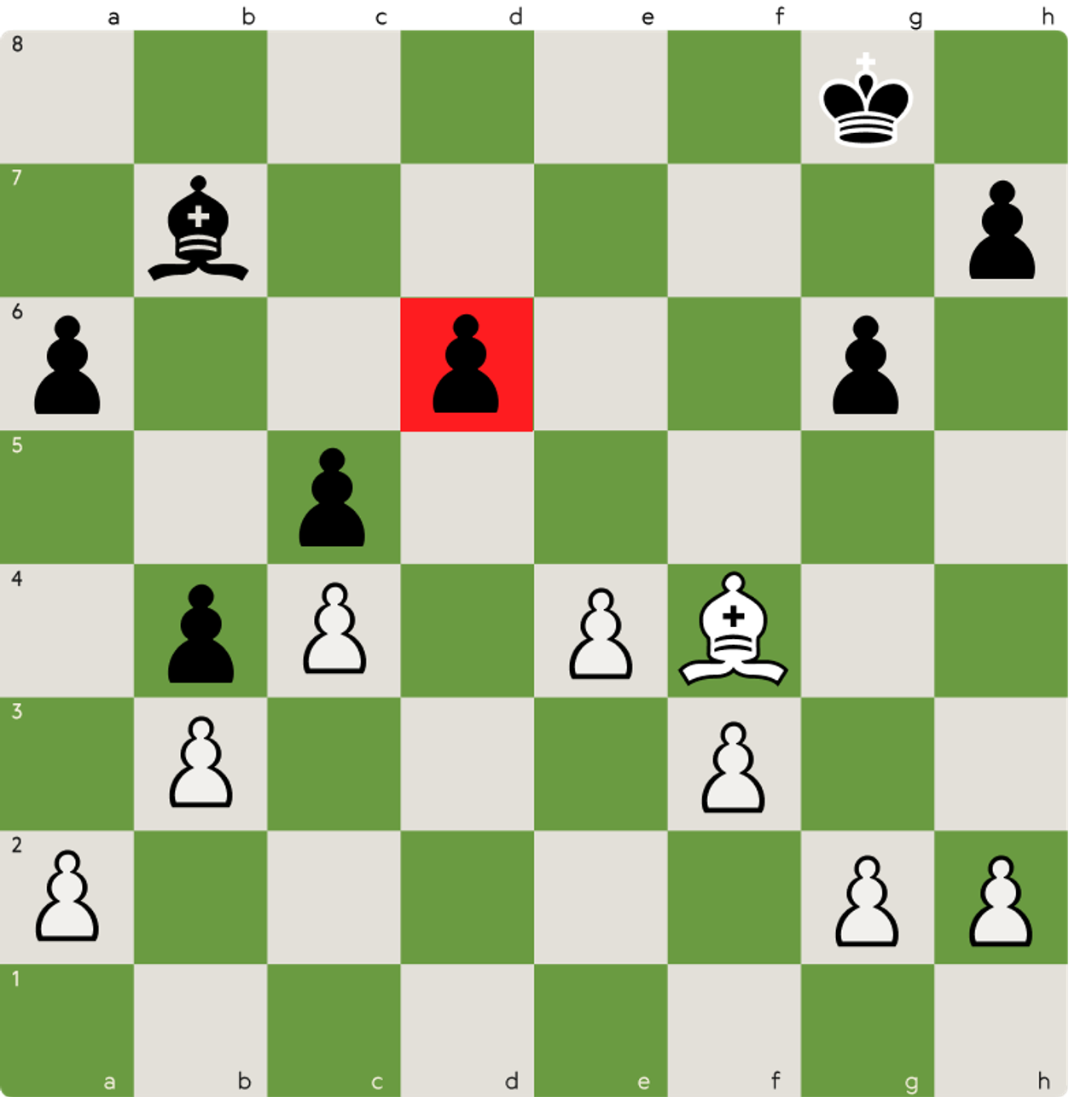
Shown in this example, the backward pawn is left behind by its fellows. And the square located in front is controlled by enemy pieces, not allowing it to advance and making movement difficult.
How a Backward Pawn Forms
Normally they appear after an exchange in the center or from ill considered pawn movement earlier on in a game.
Sometimes a player pushes one pawn too far while nearby pawns stay back. In other positions, multiple exchanges leave a single pawn without proper support.
This weakness and occur frequently with openings like the Sicilian Defense, an opening movement where asymmetrical pawn structures occur early.The weakness is especially common in openings like the Sicilian Defense, where asymmetrical pawn structures appear very early.
Listed are also common causes:
- One pawn advances while adjacent pawns remain on their original squares
- Central pawn exchanges remove natural pawn support
- Enemy control over key squares prevents safe pawn movement
- A player prioritizes piece activity instead of pawn structure
Not every backward pawn immediately loses the game. Strong players sometimes accept the weakness in return for active pieces or attacking chances.
Still, backward pawns in chess often become long-term targets because they are difficult to repair once created.
One interesting thing about chess backward pawns is that they may remain weak for the entire game. Unlike isolated tactical mistakes, structural weaknesses tend to stay on the board.
Disadvantages of a Backward Pawn in Chess
A backward pawn affects more than just one square. It can influence development, piece coordination, and long-term planning.
In many games, the player defending the weakness slowly becomes passive.
Vulnerability to Attacks
The biggest issue with backward pawns is how easy they are to pressure.
Since neighboring pawns cannot defend them properly, pieces must take over the defensive job instead. Opponents usually double rooks on the open file and increase pressure step by step.
This often forces defensive play. A rook that could be active elsewhere suddenly has to sit behind the pawn all game.
Strong positional players are patient in these situations. Rather than rushing for tactics, they simply improve their pieces and keep attacking the weak point.
Difficulty Advancing
A backward pawn usually stays frozen in place.
The square in front of it is often controlled by enemy pieces, meaning the pawn cannot safely move. If it advances anyway, the pawn may simply be captured.
This creates another problem: lack of space.
When one side cannot push pawns forward, their position becomes cramped. Pieces lose flexibility and good squares become harder to find.
That is one reason chess backward pawns are discussed so often in positional chess lessons.
Blocking Development
Weak pawns also affect development and coordination.
Players defending a backward pawn may need to keep pieces tied to defense instead of active play.
For example:
- A rook may remain stuck defending the file
- Knights lose active outposts
- Bishops may have limited movement
- The queen may need to defend instead of attack
This setup can be very frustrating to play over time. A lot of casual or club players will mainly focus on material, however the experienced player knows that a piece that is inactive can be just as damaging as a pawn loss.
Can Backward Pawns Be Acceptable?
In some positions, yes.
There are openings where players intentionally accept backward pawns because they gain something important in return. That compensation might be:
- Better development
- Active rooks
- Central control
- Initiative
- Kingside attacking chances
Variations of the Sicilian Defense are centred around this idea. Black can allow a backward d-pawn but obtains dynamic counterplay and pieces whose placement is active.
This is why chess strategy is rarely absolute. A weakness that is on one side of the board can be balanced by something occurring on the other side. To help your knowledge of pawn structures you should study isolated pawns, doubled pawns, as well as pawn chains. These concepts are closely connected.
Continue learning:
Conclusion
The backward pawn is a structural weakness that is highly common in chess. Although it may not appear as an immediate loss, it usually creates problems long-term. And an experienced opponent can push the weakness and restrict movement to improve their position.
Understanding and knowing how to identify the backward pawn allows you to make more strategic decisions. It heightens awareness and can be especially useful in slower games where the structure matters.
Like a lot of chess concepts, it is easier to understand as soon as you see it during a real game and not only in theory. Afterwards you can see how sometimes a strong player can build a whole game around a singular weak pawn.
See Also
Read more: Passed Pawn in Chess, Pawn Chain, and Pawn in Chess.