Gerard Piqué Bets On Chess: Why Sports Stars Are Suddenly Investing
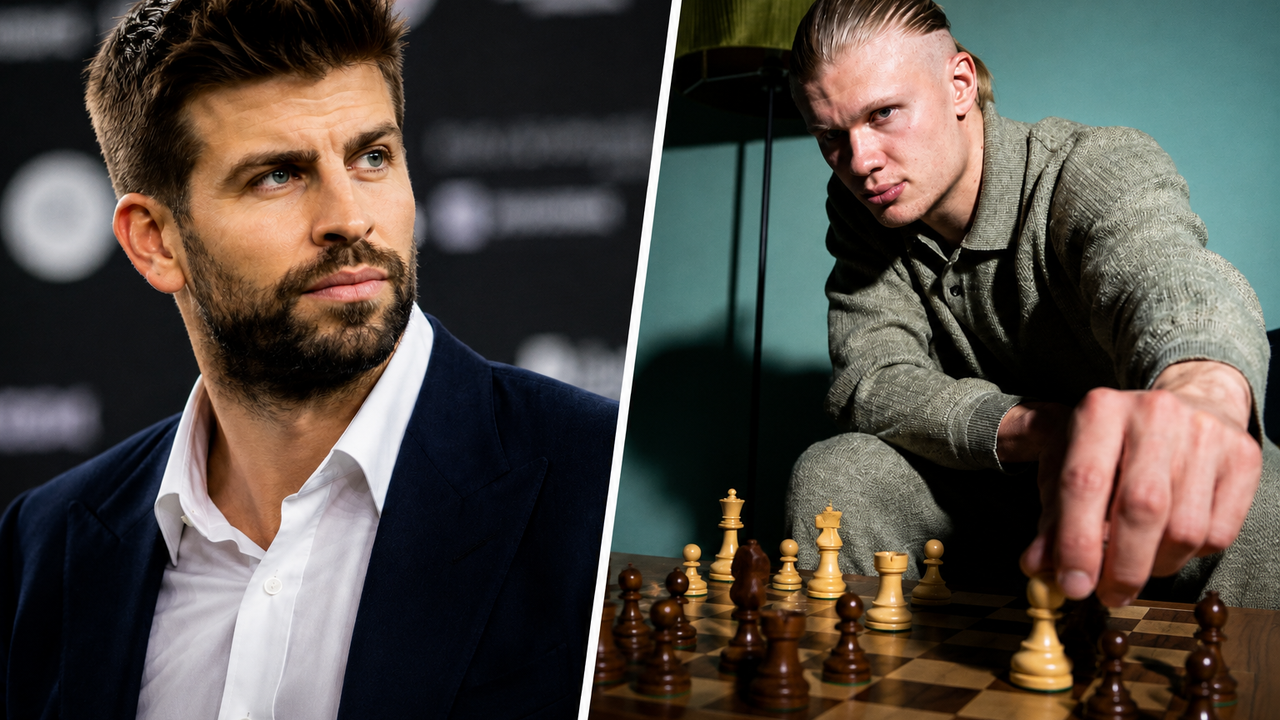
Gerard Piqué has become the latest sporting superstar to invest in chess, following Erling Haaland, Johannes Høsflot Klæbo and others. But what are they betting on?
First there was Erling Haaland, but he had a connection to GM Magnus Carlsen. Then the most successful Winter Olympian in history, another Norwegian sports hero. Now, Spain's football legend Gerard Piqué.
Something unusual is happening in chess: some of the biggest names in sport are buying into it.
Piqué, the former Barcelona and Spain defender, announced on Monday that he has become a strategic shareholder in Fyers American Gambits, one of the six franchises in the Global Chess League (GCL). He joins former India cricketer Ravichandran Ashwin, already a co-owner of the team.
Piqué is one of many footballers who have had an interest in chess. His former boss at Barcelona, Quique Setién, for example, famously had an impressive peak official FIDE chess rating of 2055, and there was believed to have been a chess circle at the club, Lionel Messi also being a player.
Piqué has also previously shown interest in the GCL, turning up for a Fyers American Gambits promo event last December. Maybe his investment dates back to then?
An iconic pre-launch moment with Gerard Piqué and John Abraham, marked by a special jersey exchange as we gear up for the Global Chess League. ♟✨@Prachura1 @fyers1 @GCLlive @3gerardpique @TheJohnAbraham @CircleChesscom @S45IBank #FyersAmericanGambits #TechMGCL #MegaMove pic.twitter.com/vKk7dGvzxm
— FYERS American Gambits (@AmericanGambits) December 10, 2025
Piqué's move to buy into the game comes only months after Manchester City striker Erling Haaland invested in Norway Chess, followed by cross-country skiing superstar Johannes Høsflot Klæbo and former cycling world champion Thor Hushovd.
Chess, apparently, is becoming an athlete's investment. But what exactly are they buying?
Piqué's Gambit
There are plenty of different versions of professional chess being marketed right now. To name just a few, the glitzy Esports World Cup chess event has just finished, with Carlsen winning again:
Showing the world who the trophy belongs to!@MagnusCarlsen lifts the Chess at EWC26 trophy. 🏆 pic.twitter.com/jBNRZbtl9E
— Esports World Cup (@EWC_EN) August 15, 2026
There are, of course, also the more traditional events like the Sinquefield Cup taking place in Saint Louis right now; and there's the Freestyle Chess revolution spearheaded by FIDE presidential candidate Jan Henric Buettner.
The GCL, first held in Dubai in 2023, is a venture bankrolled by the giant Tech Mahindra group and authorised by FIDE, the chess governing body. It's taken place each year since, in London in 2024 and Mumbai in 2025. This year, it has been squeezed into the chess calendar between September 3 and 13 and is due to take place in Bengaluru at an as-yet unnamed venue.
The chess buzz is REAL 🥳♟️
— Tech Mahindra Global Chess League (@GCLlive) August 16, 2026
Book your tickets now 🔗 👉 https://t.co/8xGdhGx5D6#TechMGCL #GlobalChessLeague #BeyondTheMove #OnlyAtGCL pic.twitter.com/qKKAwenzWc
The GCL's point of difference is that it's all about franchises, team owners, short time controls and recognisable identities rather than the traditional sequence of individual opens, invitationals and championships. Cricket fans will recognise that it is very like the chess version of the wildly successful Indian Premier League.
The American Gambits, headed last year by GM Hikaru Nakamura, are one of those franchises and will return for the league's fourth edition.
For Piqué, there is an obvious connection.
Since retiring from football, he has hard into sports entrepreneurship. Piqué's Kosmos venture has experimented with shorter formats of football, digital-first broadcasting and ways of turning established sports into entertainment products for audiences who may not sit through the traditional version.
It all sounds very familiar to chess fans.
Then There Is Haaland
Haaland's move into chess may be even more significant because his investment is tied to an attempt to create an entirely new world championship.
In March, Haaland and Norwegian businessman Morten Borge established Chess Mates, which became a significant shareholder in Norway Chess.
At the centre of the deal is the Total Chess World Championship Tour, a new FIDE-approved (and perhaps more crucially, Carlsen-approved) competition designed to find a champion across three forms of the game: Fast Classic, Rapid and Blitz.
🇳🇴 Magnus is the winner of the Esports World Cup 2026 🔥
— Total Chess (@TotalChess) August 17, 2026
With this win, Magnus has won 75 events in total 🤯♟️
Oh, and 21 of those are World Championship Titles!
Did you know that Magnus will play at the Total Chess Pilot?
The Total Chess World Championship Tour will test the… pic.twitter.com/gyaJVcpQD5
Total Chess aims to name a FIDE World Combined Champion who has to prove himself across several speeds.
Fast Classic itself is an experiment. Games can be played with as little as 45 minutes plus a 30-second increment per move while still counting for classical rating. Add rapid and blitz, and the intention is to create a championship in which versatility matters as much as classical endurance.
The pilot is scheduled for Budapest from November 10 to 24, before a full four-event season launches in 2027.
There is serious money behind it too.
The annual prize fund will be at least $2.7 million, with at least $750,000 allocated to each of the first three tournaments and $450,000 to the four-player final, plus performance bonuses.
And FIDE has approved the concept for at least 16 years.
Haaland is therefore putting his name on an attempt to build a new permanent piece of the elite chess calendar.
Norway Chess Suddenly Has Serious Backers
Then came another move.
In April, Norway Chess raised $10 million in new capital, in a deal valuing the company at $35 million.
Among the new shareholders was Johannes Høsflot Klæbo, the Norwegian cross-country skiing phenomenon who became the most decorated Winter Olympian of all time in 2026.
Former cycling world champion Thor Hushovd also joined the shareholder group, alongside former beach volleyball player and sports entrepreneur Bjørn Maaseide and a collection of Norwegian business investors.
The money is intended to help build Total Chess.
So within a matter of months, Norway Chess has gone from being known primarily for the elite Stavanger tournament—famous in chess for attracting Carlsen and experimenting with formats such as Armageddon—to becoming the company behind a well-funded attempt to create a new global championship circuit.
Ultimately, Piqué, Haaland et al are sportsmen from more commercially developed sports who appear to have eyed an opportunity in chess. They think chess can be developed in similar ways to, in Piqué's case, money-makers like IPL cricket.
It's all a risk, and an experiment with an already well-established game. Let's see if it pays off.