Should FIDE's Latest Partnership Raise Questions? Freedom Holding's Growing Role in Funding Chess
FIDE's new partnership with Freedom Holding Corp promises more investment in chess—but the company’s historical ties to Russia raise difficult questions about optics.
FIDE, the world governing body of chess, has to get its money from somewhere, right? It can't rely on membership fees.
Post Russia's full-scale invasion of Ukraine, sources of support have been thin on the ground. FIDE's Russian pipeline of cash has dried up with big name sponsors like Russian Railways and Aeroflot not acceptable anymore.
The Isle of Man-based Scheinberg family has financed a string of events including the 2024 edition of the FIDE Candidates and delivered on support for the 2026 edition as well.
Then there's Freedom Holding Corp, which joined forces with the Scheinbergs to co-sponsor the 2026 event in Cyprus, the island that houses its European HQ. Since the events of 2022, it is Freedom Holding that has effectively stepped in to replace all that missing Russian money. You must have seen it: their logo adorns nearly every big FIDE event.
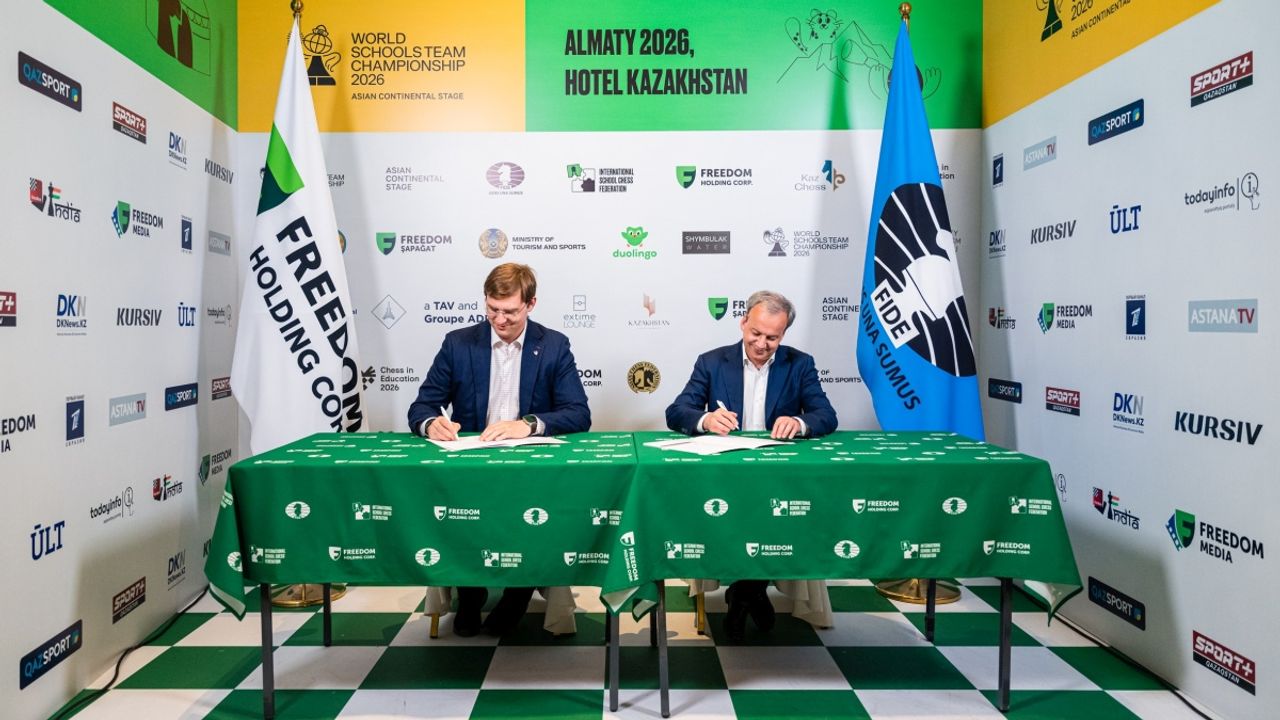
On Monday, FIDE announced a new partnership with Freedom Holding, positioning the investment firm as an official partner for its global development programmes throughout 2026.
🤝 Freedom Holding Corp becomes FIDE Partner for 2026 chess programmes
— International Chess Federation (@FIDE_chess) April 11, 2026
♟️ The International Chess Federation (FIDE) and the investment company Freedom Holding Corp have signed a Memorandum on cooperation focused on global promotion, development, and accessibility of chess.… pic.twitter.com/YfewkNEvYv
On paper, the deal looks like a major boost for chess. FIDE's website hails funding for tournaments, support for players and coaches, educational initiatives, and talent development across multiple continents. At a time when FIDE is facing problems on many fronts, the injection of private capital is both timely and significant.
But the partnership also raises an uncomfortable question: who exactly is Freedom Holding, and should the chess world be paying closer attention?
Freedom Holding's global HQ is in the U.S. and the firm listed on NASDAQ, presenting itself as an international financial services company. However, its history and operations are closely tied to post-Soviet markets, particularly Kazakhstan and, historically, Russia.
Its founder and CEO, Timur Turlov, built much of the company's early business in the Russian financial system before the firm shifted its structure and branding in recent years.
Turlov is the President of Kazakhstan Chess Federation and International School Chess Federation. Two years ago, at FIDE's General Assembly in Budapest, it was Russia's Central Asian ally Kyrgyzstan that controversially tabled a motion called for "restoring the full rights of the national chess federations of Russia and Belarus". The motion was defeated amid an international outcry, but last December two similar proposals were approved.
Here it seemed Turlov, or at least the Kazakhstan Chess Federation, was very much Russia's friend.
Timur Turlov🇰🇿, formerly 🇷🇺, has taken the stage. He is sanctioned by Ukraine🇺🇦 and his company "Freedom Holding" has admitted to handling several sanctioned clients. pic.twitter.com/oNkDolqrPA
— Peter Heine Nielsen (@PHChess) September 22, 2024
Freedom Holding has, however, publicly distanced itself from Russia following the invasion of Ukraine in 2022—reportedly divesting certain assets—questions have persisted in financial and regulatory circles about the depth and completeness of that separation.
This makes the partnership particularly delicate for FIDE, led by President Arkady Dvorkovich, a former Russian deputy prime minister.
Since 2022, FIDE has faced ongoing scrutiny over its handling of Russian participation in chess, balancing international sporting norms with geopolitical realities. Any perceived reintroduction of Russian-linked influence—direct or indirect—risks reopening those debates.
There is no suggestion of wrongdoing in the agreement itself. On the contrary, Freedom Holding's funding could provide meaningful support for players, federations, and grassroots initiatives worldwide. Chess is desperate for that.
Yet in today’s climate, how it looks is equally important.
Sports organisations across disciplines have been forced to reckon with the sources of their funding—whether from state-backed entities, politically exposed individuals, or companies with complex geopolitical ties. Chess is no exception.
The concern is not necessarily about what Freedom Holding is doing now, but about how its background might be perceived, particularly in Europe and among federations sensitive to Russian influence.
This is not the first time chess has faced such questions. The sport has long relied on benevolent patrons, sponsors, and state support from regions where politics and business are deeply intertwined.
The challenge for FIDE is clear: how to secure the financial backing needed to grow the game while maintaining credibility, transparency, and trust.
So should the chess world be worried? With a FIDE leadership election coming up in September, and much chat about who will run, should Dvorkovich himself be worried? That is another question entirely.
There is no immediate red flag in the partnership itself, and the benefits for chess development could be substantial. But the relationship will likely be watched closely—by players, federations, and observers alike.
And as this partnership continues, one thing is certain: it isn't just about chess.