Russia's Deadline To Stop Hosting Chess Events In Ukraine Passes: What Will FIDE Do?
Russia faces a maximum three-year suspension if it is found to have continued chess tournaments in occupied lands. FIDE will now decide whether to enforce that.
The issue zeroes in at the very heart of chess politics—and wider geopolitics, for that matter.
In March, Russia's chess federation was given an ultimatum by the highest authority in sport: stop organising events and asserting control in occupied Ukrainian territories within 90 days or face suspension from FIDE of up to three years.
Now, as of June 9, Lausanne-based Court of Arbitration for Sport (CAS) deadline is up. Russia must comply or, supposedly, be suspended.
The Unthinkable
Imagine that, the super-power Chess Federation of Russia (CFR), one of the biggest and unquestionably the most influential members of FIDE, turfed out of the governing body of chess. And in a key election year.
Could this really happen?
The ball is now in FIDE's court.
On Monday, as the deadline passed, the federation reacted by posting a notice on its website saying the FIDE Council has, as a result of the CAS ruling, formally requested the CFR provide evidence of its compliance with the decision.
The Implications
If FIDE ignores the CAS decision, it risks losing its International Olympic Committee status, which it gained in 1999. If that goes it will be a hammer blow to national chess federations around the world. In many countries government sports funding is linked to IOC affiliation. Break that link, and federations may find their funding evaporates. That is unlikely to directly affect Russia, however the CFR may find its voting allies in FIDE are angered. For Russia, that could potentially mean a knock-on effect at the FIDE General Assembly later this year.
The CAS ruling replaced an earlier 45,000 euro ($51,800) fine imposed by FIDE, which had been seen as nothing more than at best a slap on the wrist, at worst just a performative sanction.
However, CAS's decision significantly toughening the sanction in a long-running dispute brought by the Ukrainian Chess Federation. CAS already suspended indefinitely the Russian Olympic Committee for violating Ukraine's territory in 2023.
CAS upheld findings that the Russian federation breached FIDE rules by incorporating and organising chess activities in regions internationally recognised as part of Ukraine, including Crimea and areas of Donetsk, Luhansk, Kherson and Zaporizhzhia.
Several chess commentators such as the outspoken GM Peter Heine Nielsen have repeatedly highlighted the existence of such events, held under a Russian flag.
Heine Nielsen has been stinging in his criticism of FIDE for failing to clamp down on CFR activities and claims 1350 events have been organised, "with FIDE turning the blind eye, and doing nothing."
The Russian 🇷🇺 Chess Federation President calls on Ukraine 🇺🇦 to avoid " legal wrangling", on the day when the deadline for Russia to accept the CAS Verdict expires, and stop their illegal activities in Occupied Ukrainian territories. https://t.co/eZRO50qCzk pic.twitter.com/RljzwW62O6
— Peter Heine Nielsen (@PHChess) June 9, 2026
According to FIDE, a meeting of the FIDE Council has been scheduled for June 17 to assess the implementation of the CAS decision and to take any decisions in accordance with the FIDE Charter.
For the Ukrainian Chess Federation, this was not good enough.
A statement posted on the UCF's Facebook page on Tuesday read: "The Council of the International Chess Federation (FIDE) has sent a request to the Chess Federation of Russia (CFR) demanding to provide evidence of the execution of the decision of the Sports Arbitration Court (CAS) to cease activities in the temporarily occupied territories of Ukraine.
"We remind you that in accordance with CAS decision in CAS case 2024/A/10911 of March 11, 2026, the CFR was supposed to fulfil this decision by June 9, 2026. Exactly for 90 days of the Federal Republic had to stop regulating chess competitions in the Crimea, Sevastopol, Donetsk, Luhansk, Kherson and Zaporizhia regions. In the event of failure to comply with the CAS decision, the membership of the FIDE is automatically suspended for three years (after fulfilling the requirements, the membership is automatically renewed)."
It added: "The CFR has consistently and publicly stated that it does not intend to implement this decision. Accordingly, the Chess Federation of Ukraine expects from FIDE the full and immediate implementation of the CAS decision, including the suspension of the membership of the CFR. Respect for CAS decisions and fundamental principles of international sport is a must. Illegal activities of CFR in the occupied territories of Ukraine cannot be tolerated."
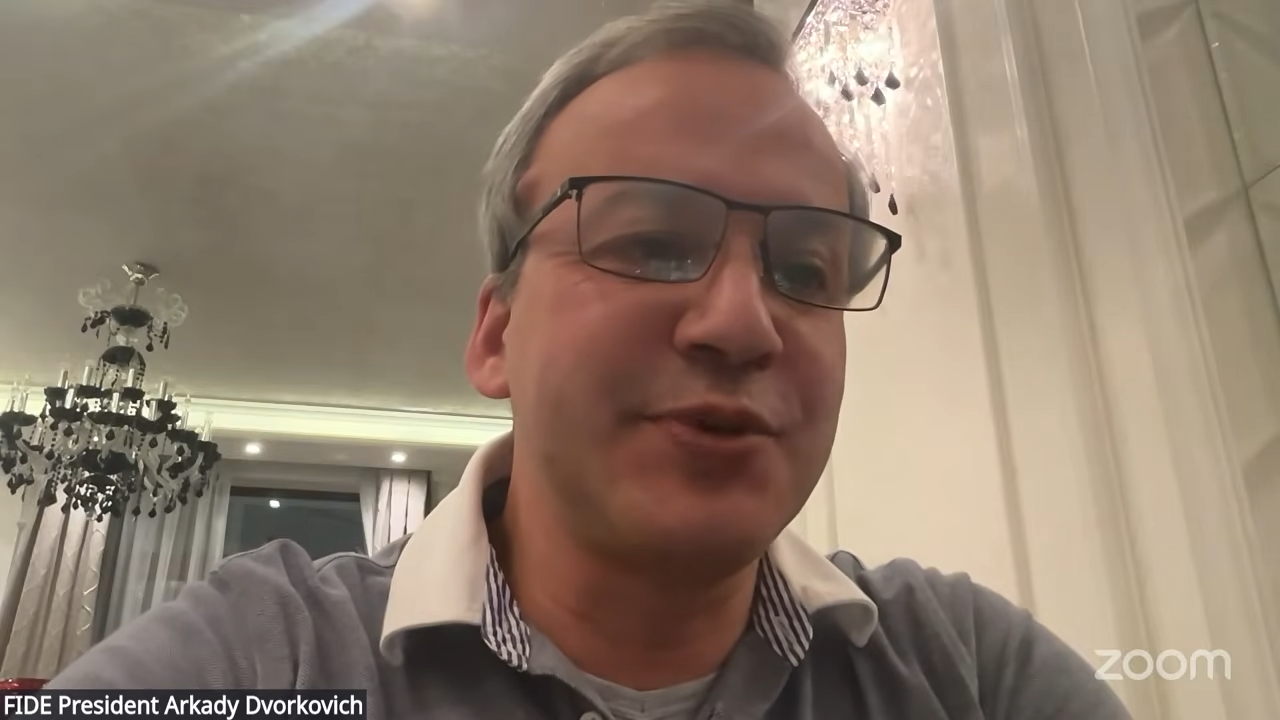
FIDE is, of course, currently led by Arkady Dvorkovich, a former deputy prime minister of Russia, who was named in the case as the "Second Respondent". FIDE and the CFR were also defendants in the case.
Dvorkovich is up for re-election later this year, and only last week was confirmed as the CFR's preferred candidate. In cases likes this, however, his job is to be neutral.
Dvorkovich also doesn't have total control over FIDE. The FIDE Council is a separate arm of the executive and has challenged Dvorkovich's positions in the past.
The Council has already been called upon to rule on one highly-divisive FIDE decision this year regarding Russia.
Following the FIDE General Assembly's vote to return Russian and Belarusian teams and allow juniors from those nations to return to competition, the Council was asked to finalise protocols for adult teams following IOC consultation.
A group of five rebel federations responded to the decision by taking another case to CAS, which is currently awaiting a verdict.
The Ukrainian Chess Federation is leading the action with support from England, Norway, Estonia and Germany.
The court battles don't end there.
Earlier this month, the CFR fired its own broadside announcing it has filed an ethics complaint with FIDE against Ukrainian Chess Federation President Oleksandr Kamyshin for alleged warmongering.
In comments that were widely reported across state-owned media in Russia, the CFR alleged Kamyshin has been violating FIDE's ethical standards since his appointment through a series of posts on social media.
On Monday, the Russian state-owned news agency TASS reported comments from CFR president Andrey Filatov in which he claimed the Ukrainian federation, "is engaged in legal wrangling, trying to divide FIDE members."
Filatov also said, without a hint of irony: "I urge everyone to separate sport from politics, and the Ukrainian Chess Federation to focus on developing chess within its borders."
It's not clear what will happen—if anything—in the coming days. But whichever way it swings, nobody can pretend to be keeping the politics out of chess.