Timur Turlov, The Accidental Candidate
Timur Turlov signed up to be chess's No. 2. Then, on a Thursday in July, Brussels made him the story.
For three and a half weeks, Timur Turlov had the most comfortable job in chess politics. The 38-year-old billionaire — founder of Freedom Holding, president of the Kazakhstan Chess Federation, the man who this spring bought ChessBase — had agreed to run for Deputy President of FIDE on the ticket of the incumbent, Arkady Dvorkovich. The arrangement had a certain elegance. Dvorkovich, seeking a third term he once promised himself he'd never need, would carry the political weight. Turlov would bring the money, the youth, the growth story. The election, in Samarkand this September, looked less like a contest than a coronation with paperwork.
Then came July 23.
On Thursday, the European Union added Dvorkovich to its 21st sanctions package against Russia, citing his years as a Kremlin deputy prime minister and accusing him of using the chess federation's highest office to lend legitimacy to Moscow's war aims — including, the EU noted, his habit of referring to occupied Ukrainian regions as Russia's "new territories."
Within hours, Dvorkovich announced he would voluntarily suspend his powers as FIDE President, calling the measures "unlawful and unfair" while conceding they would make it rather difficult to run an international federation headquartered in Switzerland. Viswanathan Anand, the five-time world champion serving as Deputy President, became interim president of world chess by charter default — arguably the most qualified man ever to hold the job, holding it by accident.
Which leaves the Dvorkovich ticket with a problem, a deadline, and exactly one obvious answer. Nominations for the FIDE presidency close on July 26. The election is September 26–27, at the General Assembly in Samarkand, alongside the Chess Olympiad. The campaign built around an incumbent who can no longer plausibly hold the office must decide, within days, whether its deputy candidate becomes its presidential one.
The man who bought the board
Turlov's biography reads like something a screenwriter would soften for plausibility. Born in 1987, he founded Freedom Finance in 2008, barely out of his teens, selling Kazakh and Russian retail investors access to American stocks. The company that grew out of it, Freedom Holding Corp., is now Nasdaq-listed, with revenues north of $2 billion and a market capitalization above $8 billion; Forbes puts Turlov's personal fortune at roughly $5.5 billion. In 2022, as the war redrew every map that mattered to him, Turlov renounced both his Russian and St. Kitts and Nevis citizenships and became a citizen of Kazakhstan — a decision that was equal parts conviction and corporate necessity, and which he has treated ever since as the founding act of his public life.
Since taking over the Kazakhstan Chess Federation in 2023, Turlov has run it less like a sports body than a growth-stage startup. Chess is now taught in more than 1,500 Kazakh schools to over 60,000 students. In 2025, Kazakh players brought home 162 international medals, 64 of them gold, and the country's women's and youth teams have become fixtures at the top of world rankings. He founded an International School Chess Federation in 2024. Freedom pours roughly $15 million a year into the game — and in April, it acquired ChessBase, the Hamburg company whose database software has been the sport's professional infrastructure for four decades, committing another €5 million to its development.
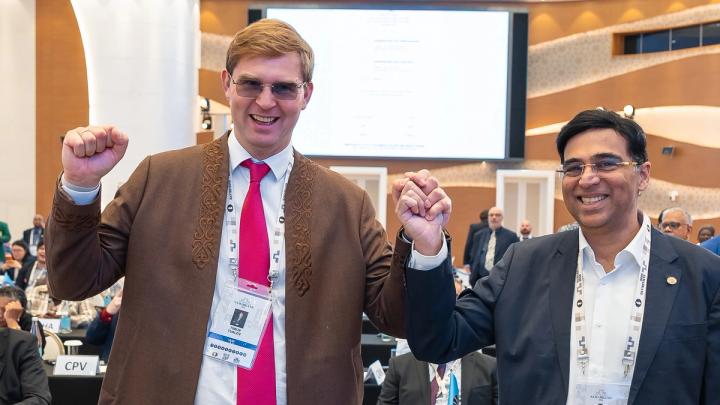
When Turlov joined the ticket on June 29, his pitch was the pitch of every founder who has ever raised a Series B: the model works, now we scale. "The results achieved over these 3.5 years have convinced me of a simple thing," he said. "The approach we're using in Kazakhstan works, and it can be scaled up much more broadly — to the level of world chess." He talked about digital transformation and AI integration. He was, in other words, running for chief operating officer of chess. He may now be about to become its chief executive.
The irony clause
There is a complication, and it is the kind that makes this race irresistible. Turlov knows sanctions lists from the inside. Ukraine froze billions of hryvnias belonging to Freedom's local subsidiary and sanctioned Turlov personally — measures the company has spent years contesting, calling its inclusion an error and pointing to its exit from Russia, where Freedom sold off its entire business after the invasion.
His defenders will note the obvious counterpoint: Turlov is precisely not Dvorkovich. He holds no Russian passport. He never sat in a Russian cabinet. His fortune is listed on a New York exchange and audited accordingly, and his federation answers to Astana, not Moscow. If the chess world's governing coalition — the roughly 100 federations that were notionally behind Dvorkovich this spring — wants continuity without contamination, Turlov is the cleanest version of it on offer. That this is true, and that it is also exactly what the coalition needs to be true, is the kind of ambiguity FIDE elections are made of.
The other men who would be king
The opposition smells blood for the first time since 2018. One of the other contenders, Jan Henric Buettner — the German entrepreneur who built AOL Europe in the nineties, then built the Weissenhaus resort, then built Freestyle Chess with Magnus Carlsen — is running a listening-tour campaign with the English organizer Malcolm Pein as his deputy, and he wasted no time framing Thursday's news: FIDE, he said, must finally prove it can be independent and politically neutral. His problem is arithmetic. FIDE's electorate is some 200 national federations, one vote each — Andorra counts the same as India — and the decisive bloc is Africa's 54 federations, terrain where Western reform candidates have historically gone to die. Wadim Rosenstein, the other German in the race, commands a cluster of European reformists whom Buettner's camp is now openly courting. And circling the whole thing, on a self-financed tour through Zambia, Zimbabwe, Kenya, and Botswana, is Kirsan Ilyumzhinov — the man who ran FIDE for 23 years, and had his U.S. sanctions lifted last summer, a detail he mentions often.
The board, then, is set with a strange symmetry. One candidate made his money on the early internet and wants to liberate chess from its politics. One spent two decades running chess as a personal fiefdom and wants it back. And one — the youngest, the richest, the least expected — woke up this week to find that a sanctions package aimed at someone else may have handed him the oldest game's highest office, three days before the filing deadline and two months before his 39th birthday.
In Samarkand, a city that has watched empires change hands for 2,500 years, the delegates will decide whether chess's next era belongs to the man who planned for it — or the one who had it thrust upon him on a Thursday afternoon.
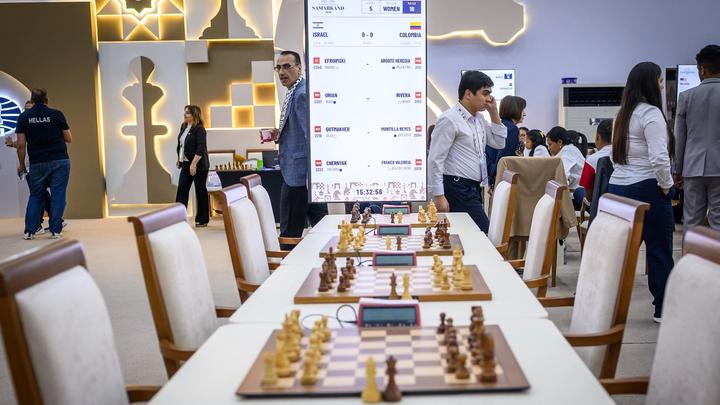
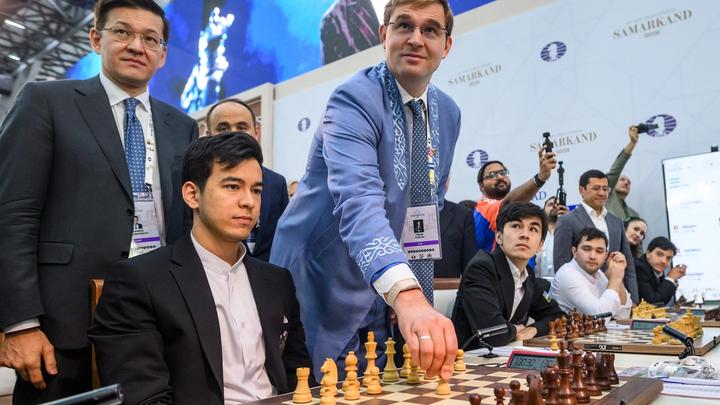
The FIDE presidential election takes place September 26–27, 2026, at the 91st FIDE General Assembly in Samarkand, Uzbekistan.