FIDE Election 2026: The Latest Standings (By Our Reckoning)
With no obvious winner in sight, World Chess looks at the electoral maths that will decide who controls FIDE for the next four years.
At World Chess HQ, we are all transfixed by the 2026 FIDE Election. Forget Elo ratings or how many world titles GM Magnus Carlsen has notched up, the number that matters in world chess politics right now is 100.
Or more precisely, whatever it takes to get a majority in FIDE's big, hugely consequential vote next month.
But with a month to go, who is ahead? Can anyone really tell?
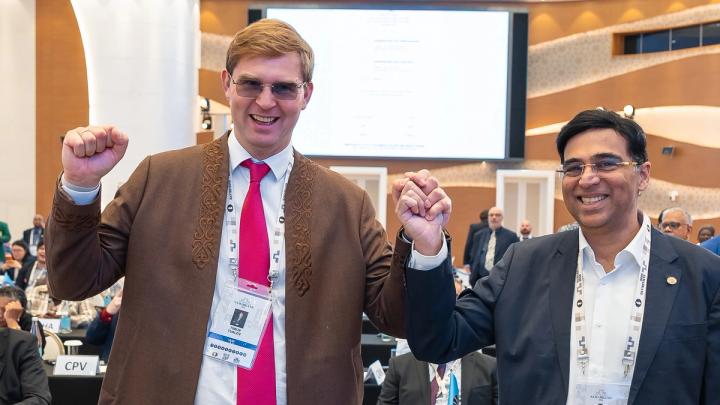
Three tickets are officially in the race: Timur Turlov and Viswanathan Anand; Wadim Rosenstein and Gordon Tang; Jan Henric Buettner and Malcolm Pein. And after weeks of endorsements, arguments and increasingly energetic campaigning, the first outlines of an electoral map are beginning to emerge.
The problem is that FIDE elections are notoriously difficult to predict.
The behemoth that is India has one vote. The United States, a superpower of the game, has one vote. Germany, which has nearly 100,000 members, has one vote. And so do Aruba, Gambia and almost every other eligible member federation.
Chess strength, population, number of grandmasters and number of registered players make no difference.
Controversially for some, FIDE's voting system is one federation, one vote. Some maintain it's democracy in action, others say it's a rigged system that's absolutely wide open for abuse and corruption.
So where are they going?
The Votes We Actually Know
Firstly, we have to caveat everything by saying we don't trust what anyone's saying at this moment. FIDE elections are notorious for last-minute changes of heart, blatant back-stabbing and, for want of a better phrase, dodgy back-room dealing.
So the safest starting point is probably FIDE's own Electoral Commission. Here at least, we have a matter of official record.
Each presidential ticket needed nominations from at least five federations, including representation from all four FIDE continents, and could submit a maximum of eight.
All three reached eight.
Rosenstein / Tang: Germany, Panama, Sudan, Thailand, Mongolia, Latvia, Bolivia and Mozambique.
Turlov / Anand: Aruba, Austria, Colombia, Italy, Kazakhstan, Moldova, Morocco and Tanzania.
Buettner / Pein: Bermuda, England, Gambia, Monaco, New Zealand, South Africa, Wales and Ireland.
FIDE also says Turlov received another federation endorsement directly, which could not be included because his ticket had already reached the maximum of eight.
Since then, Rosenstein has been particularly active in announcing new support on his social media.
His campaign has publicised further federation endorsements from France, Poland, Montenegro and Albania, taking his publicly identifiable total to at least 12.
So, if we were running an election-night scoreboard today, it would look something like:
Rosenstein: 12+
Turlov: 9+
Buettner: 8+
But that doesn't tell us much about who is actually winning.
Turlov's More Important Number: 157
Turlov has something potentially more valuable than public endorsements: Arkady Dvorkovich's electoral network. Turlov's critics say this is manifestly unfair.
He did not begin this election as Dvorkovich's opponent. He began it as his running mate.
After Dvorkovich was sanctioned by the European Union and suspended his FIDE presidential activities, the ticket was reshaped. Turlov moved to the top and Anand—Dvorkovich's Deputy President and now FIDE's interim President—joined him.
Turlov is therefore the continuity candidate. And the coalition he could inherit was enormous. In 2022, Dvorkovich and Anand won the FIDE election by 157 votes to 16.
Happy to introduce another member of my team – Carol S. Williams Pesqueira from Aruba.
— Timur Turlov (@TurlovforChess) August 13, 2026
Carol is a Board Member of the Aruba Chess Federation and the official FIDE delegate of the country. She has more than 35 years of experience in public and sports administration.
Aruba is a… pic.twitter.com/79zy4csbDv
Nobody should simply put those 157 votes into Turlov's column. Four years have passed, the geopolitical situation has changed dramatically and federations have their own interests.
But neither should anyone assume Dvorkovich's relationships with national federations disappeared when his name came off the ballot.
If Turlov inherits even a substantial part of that coalition, his real starting position could be very different from his public tally.
Russia Has No Vote—But It Still Matters
There is another strange feature of this election: Russia cannot vote, but Russian influence can.
The Chess Federation of Russia is suspended and therefore has no ballot in Samarkand. But Russia's influence in international chess has never depended on a single vote.
Dvorkovich's administration spent eight years developing relationships with federations across Africa, Asia and elsewhere. Some of those countries have also traditionally maintained close sporting and institutional ties with Russia.
That does not make them "Russian votes", and it would be wrong to assume Moscow controls how any federation votes in a secret ballot.
But those relationships are part of the electoral landscape.
Turlov was Dvorkovich's chosen running mate. Anand provides another direct link to the previous administration. Turlov and Dvorkovich were also working together on international chess-development projects shortly before the ticket changed.
So one of the biggest questions in this election is not where Russia's vote goes. Russia doesn't have one.
It is where Dvorkovich's votes go.
Rosenstein's Visible Momentum
Rosenstein, meanwhile, is pursuing a very different strategy.
His campaign has made a point of announcing endorsements as they arrive, creating the clearest publicly visible coalition of the three candidates.
France is a particularly significant addition. French Chess Federation president Eloi Relange has joined Rosenstein's campaign team.
Rosenstein has also announced support from prominent chess officials and personalities, including influential figures in African chess.
Thank you to the Mozambique Chess Federation and its Chairman, Milton Botão Francisco Patrício, for this strong and public endorsement of my candidacy for the FIDE Presidency.
— Wadim Rosenstein (@WadimRosenstein) August 14, 2026
Your words about Africa being a partner in FIDE’s future, not an afterthought, reflect exactly what we… pic.twitter.com/UCSNdMWqSk
Those personal endorsements should not be counted as federation votes, but they matter in a campaign where relationships between national federations can be decisive.
For now, Rosenstein can legitimately claim to be ahead in the public endorsement race. Whether he is ahead in the actual election is another question.
Don't Forget Buettner
Buettner is perhaps the hardest candidate to measure.
His campaign has been much less active than Rosenstein's in announcing federation endorsements publicly, which makes an X-based headcount particularly unreliable.
The 203 national chess federations are not clients of FIDE.
— Jan Henric Buettner (@JanHBuettner) July 27, 2026
They are its owners.
Owners should share in the success they help create.
That is why Malcolm Pein and I are making a clear written commitment:
20% of all FIDE revenue (excluding prize funds) will be distributed…
His running mate IM Malcolm Pein, however, has decades of experience in international chess and extensive relationships within European chess administration. He has also carved out a reputation as the de facto leader of the anti-Russian coalition in Europe.
It's worth noting that Buettner's eight original nominations also stretch across all four FIDE continents.
Buettner's message that FIDE's national federations should be treated as its "owners", not its clients, is telling. It isn't primarily a pitch to chess fans, it is a pitch to the people who hold the votes.
And What Happens If Nobody Gets 100?
With three serious candidates, the most important number on election day may initially be third place.
If nobody wins the required majority on the first ballot, the question becomes where the supporters of the weaker ticket go next.
That could get uncomfortable.
Buettner and Rosenstein are competing for many of the federations that want a change from the Dvorkovich era, but relations between their campaigns have become increasingly hostile.
Could one eventually persuade the other's supporters to unite behind him?
Or could their rivalry split the opposition vote and help Turlov?
Turlov has the reverse problem. His strongest electoral asset is continuity, but that also makes him the obvious candidate for those seeking a break with the previous administration to unite against.
In a three-way election, second preferences matter.
So Who Is Ahead?
Publicly, our rough count is:
Rosenstein: 12+
Turlov: 9+
Buettner: 8+
Privately? Nobody outside the campaigns can credibly know.
Rosenstein currently has the most visible momentum. Buettner may have support inside established chess networks that isn't showing up on social media.
And Turlov may have the biggest invisible advantage of all: the opportunity to inherit a substantial part of the federation coalition that gave Dvorkovich 157 votes four years ago.
That is what makes the 2026 election so fascinating.