FIDE Hands Russia A Propaganda Victory As Russian University Wins World Championship
President of the Chess Federation of Russia congratulates winning team and hails "wonderful gift to Russian fans." But FIDE says this isn't a team representing Russia.
It happened. Ural State Mining University has become the 2026 FIDE World University Team Champion.
For FIDE, it is an entirely legitimate sporting result. For Russia, it is also a powerful symbolic victory. FIDE's critics, however, will see it as yet another predictable and convenient capitulation to the Russian influence appears to dominate the governing body of chess.
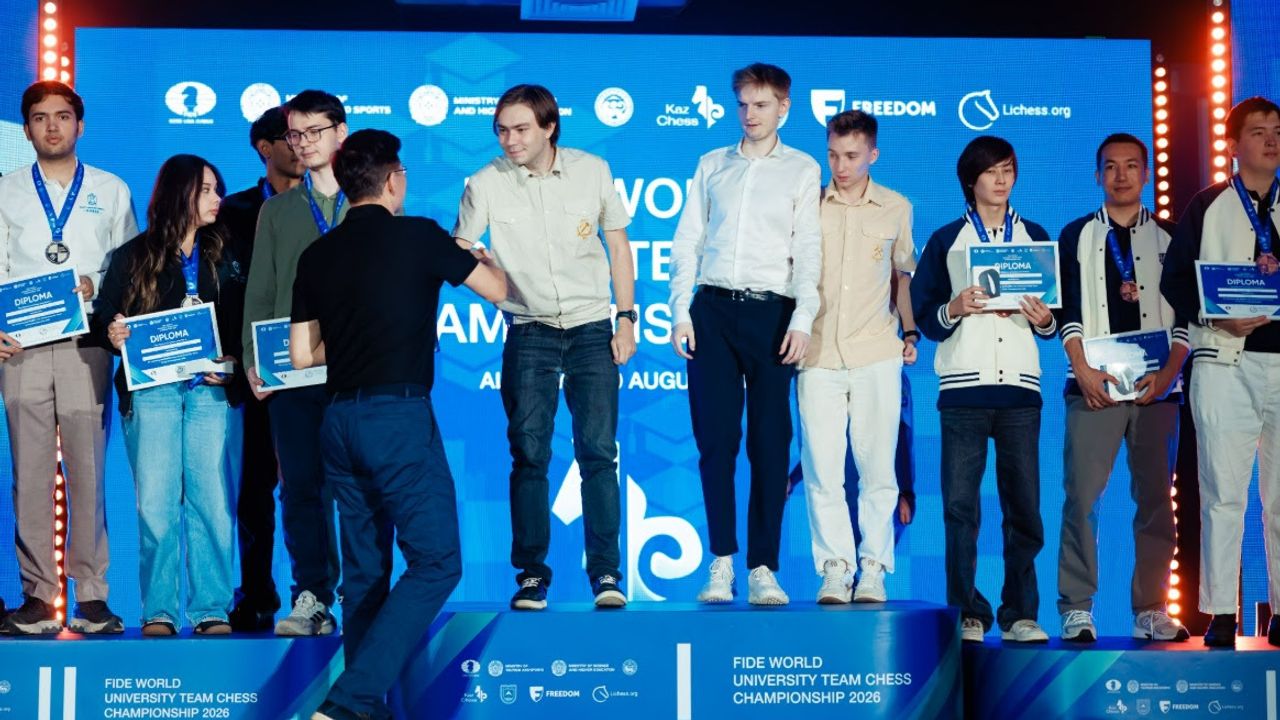
Ural State Mining University won the inaugural FIDE World University Team Championship in Almaty on Sunday, defeating Saint Louis University 5-3 across two matches to claim the title.
In chess terms, it's a fairly minor tournament, akin to the World Corporate Chess Championship. The result itself was decided over the board. IM Leya Garifullina was the star of the final, winning both of her games against WGM Thalia Cervantes Landeiro to give the Russian university decisive victories of 2.5-1.5 in each match.
🏆 Ural State Mining University wins inaugural FIDE World University Team Championship
— International Chess Federation (@FIDE_chess) August 9, 2026
The inaugural FIDE World University Team Championship Finals concluded with an official closing and awards ceremony, bringing together players, officials and guests after six days of… pic.twitter.com/eCkBjitA8I
But the significance of the result goes beyond the event itself.
For the first time since Russia's invasion of Ukraine, a team from a Russian university has won a FIDE-branded world championship title in a team competition.
And FIDE has provided the stage, the trophy and the official ceremony. This is despite FIDE being in the midst of a hugely-important election campaign where the influence Russia exerts on it is (once again) a central and deeply divisive issue.
Ukrainian GM Mikhail Golubev, who lives in Odesa, made his feelings clear on the matter on X following a nighttime Russian attack on his home city:
My home city #Odessa #Odesa 🇺🇦 is under another strong Russian drone/missile attack this night, but I decided to record my greetings to the World University Chess Championship. #FIDEUniversityChess pic.twitter.com/uwrw6u6l4u
— Mikhail Golubev 🇺🇦 (@mikhail_golubev) August 9, 2026
Golubev's question of why a Russian team was allowed to compete is relevant.
FIDE's defence is that there is an important distinction.
Ural State Mining University is not the Russian national team, it said. It represents a university rather than the Chess Federation of Russia, and FIDE therefore argued that its participation in the World University Team Championship was fully legitimate.
That distinction was at the centre of the controversy before the tournament.
But the comments made Andrey Filatov, president of the Chess Federation of Russia, immediately after the result came in suggest there is no distinction.
A Russian Team, Whatever The Label
Filatov wasted no time congratulating the university, saying: "I congratulate our chess players—the students of the Ural State Mining University—as well as the university administration, coaches, and everyone who supports Russian athletes, on this major success!
"Russian chess players have now won every team tournament they were admitted to: the World U16 Olympiad, the Women’s World Team Championship, the Olympiad for players with disabilities, and other competitions.
"This latest convincing victory is a wonderful gift to Russian fans and sports enthusiasts—and it comes just days after the National Sports Day. I congratulate everyone on both the victory and the holiday!"
So there you have it—if it looks like a duck, swims like a duck, and quacks like a duck, then it probably is a duck.
But let's be fair to FIDE. Maybe FIDE is not lying. There is an important qualification that needs to be understood.
In March 2022, FIDE suspended the national teams of Russia and Belarus from official FIDE tournaments, explicitly drawing a line between team and individual participation. Russian players could continue competing in individual events, but under the FIDE flag.
FIDE Director-General Emil Sutovsky described the policy at the time as a "balanced and fair" decision, saying that Russian and Belarusian teams were being suspended while individual players would retain the opportunity to compete under the FIDE flag.
FIDE's position on Russian teams changed in December 2025, when the General Assembly adopted a resolution providing for the return of Russian and Belarusian teams to official FIDE tournaments. World Chess covered that extensively. FIDE said the Council resolution was immediately applicable, with teams from Russia and Belarus admitted to official FIDE tournaments.
That means it would be inaccurate to describe Ural State Mining University as having broken through an unchanged FIDE ban.
The more interesting question is what FIDE's new policy means in practice.
A Russian institution entered a FIDE world championship. It competed against universities from the United States, Kazakhstan and elsewhere. It reached the final. It won. And its victory was celebrated at an official FIDE closing ceremony.
There were no neutral-team compromises to explain. No Russian flag was required for the result to have political symbolism. However, onlookers will have noticed the players' kit had "Russia" emblazoned across their chests. The name of the institution itself did the rest of the work.
Propaganda Writes Itself
This is precisely why the tournament represents such a valuable propaganda opportunity for Russia.
The Russian government does not need FIDE to declare that sanctions have ended. It does not need a Russian national anthem to be played or a Russian flag to be raised.
The headline is enough: Russian university wins FIDE World Championship.