Russia, The World's Chess Superpower, Suspended From FIDE For Holding Events In Ukraine
The unthinkable has happened: FIDE has been forced to act.
For the first time in modern chess history, the federation representing the world's most dominant chess nation—both over the board and on it—has been suspended from FIDE.
On Wednesday evening, the International Chess Federation (FIDE) announced the temporary suspension of the Chess Federation of Russia (CFR) after it failed to comply with a Court of Arbitration for Sport (CAS) ruling requiring it to cease organising chess activities in occupied Ukrainian territories.
The decision marks the culmination of a legal battle that has become a political lightning rod in chess since Russia's invasion of Ukraine in 2022.
After yesterday's news of the EU proposing sanctions against #FIDE president Arkady Dvorkovich, his administration panic-rushed the Council meeting which was supposed to be held on 17 June for ...tonight(!) via ...whatsapp(!!). Dvorkovich is now literally forced to tolerate some… pic.twitter.com/tEqcJtmT5I
— George Mastrokoukos (@GMastrokoukos) June 10, 2026
In March, CAS ruled that the CFR had violated FIDE's territorial integrity rules by incorporating and administering chess organisations in occupied regions of Ukraine. The court ordered Russia to stop organising chess activities there within 90 days or face suspension of up to three years.
That deadline expired on June 9.
On the day itself, FIDE acknowledged the deadline was approaching and had scheduled a Council meeting for June 17 to determine whether Russia had complied. But events moved much faster than expected. But FIDE couldn't wait a week. Within 24 hours, late on June 10, FIDE's Council held an emergency meeting, via WhatsApp, and concluded that the CAS requirements had not been fulfilled within the prescribed timeframe. An automatic suspension followed immediately.
Will It Change Anything?
The significance of the decision is difficult to gauge.
Russia is not just another chess federation. It is the historical superpower of the game, home to generations of world champions from the GMs Mikhail Botvinnik and Garry Kasparov to Vladimir Kramnik and Ian Nepomniachtchi. Soviet and Russian players have dominated elite chess for much of the last century. Yet despite that legacy, FIDE found itself with little room to manoeuvre.
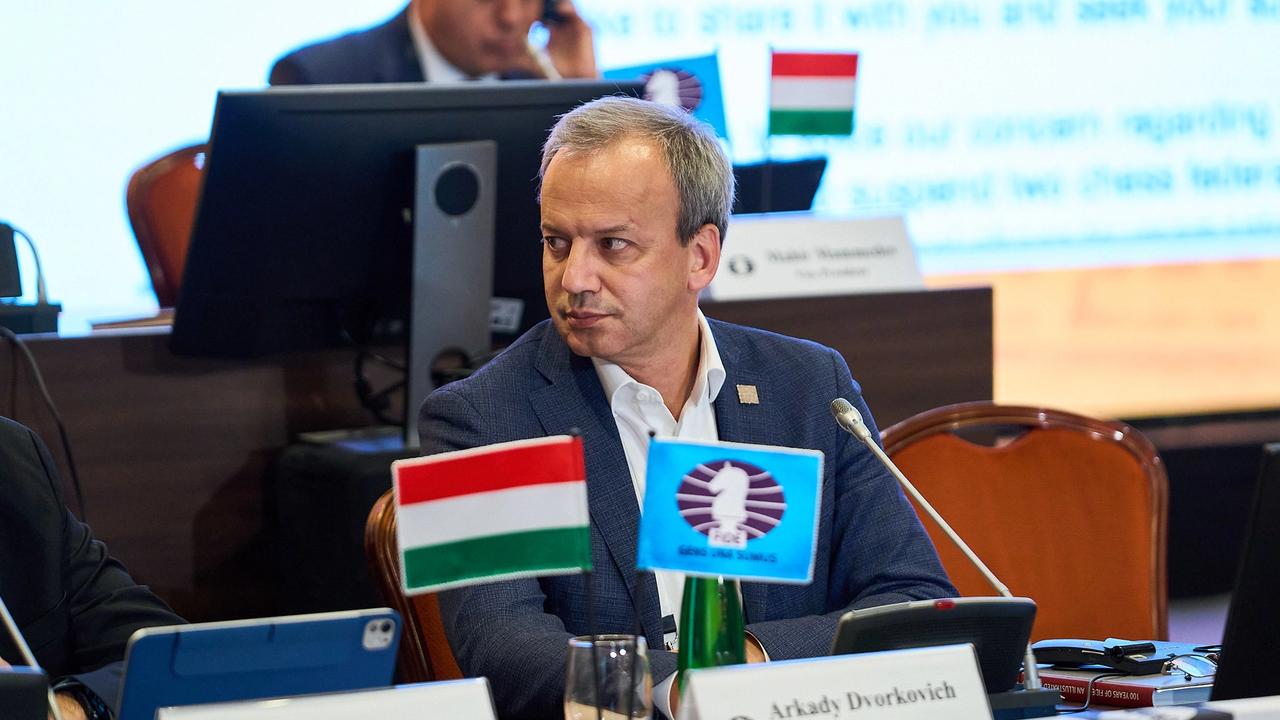
But will Russia stop the activities that have cost it its place at the top table of chess? Probably not. The Ukraine tournaments will continue, perhaps with even fewer constraints. The president of FIDE, the former deputy prime minister of Russia Arkady Dvorkovich, remains in post in FIDE's election year.
As the European Chess Union bluntly put it on the day of the decision, FIDE had "no alternative but to implement the CAS ruling."
#chess #FIDE A very direct and powerful reply by @ECUonline president Azmaiparashvili to the Filatov/Dvorkovich nonsense... Well said Zurab 👍🇺🇦🇬🇪https://t.co/PXjghnWcNm @Chessdom @Chessbase @ChessbaseIndia @TelegraphChess @ChessProblem @Chess__News @GoranUrosevic @TarjeiJS… pic.twitter.com/WhKez9Cidl
— George Mastrokoukos (@GMastrokoukos) June 10, 2026
The suspension itself, however, may be only the beginning of a new controversy.
Within hours of the announcement, critics accused FIDE President Arkady Dvorkovich's administration of trying to soften the practical consequences of the sanction.
Among the most vocal was George Mastrokoukos, a former FIDE and European Chess Union official who argued that FIDE was attempting to create legal "loopholes" that would preserve benefits for Russia despite the suspension.
His criticism focused on two points.
First, he noted that Article 13.6 of the FIDE Charter states that a suspended federation forfeits its rights and that its officials and national teams may not participate in FIDE activities. Yet FIDE's resolution simultaneously suggested that teams composed of Russian citizens could potentially continue participating under a neutral flag, subject to future Council decisions.
Second, Mastrokoukos argued that FIDE's decision to submit the issue to a future General Assembly vote appeared inconsistent with the CAS ruling's supposedly final and binding nature. In his view, once CAS had ruled and the compliance deadline had passed, there was nothing left for delegates to approve.
The broader accusation was familiar: that FIDE's leadership remains reluctant to impose the full consequences of sanctions on Russian chess and continues searching for ways to accommodate Russian participation wherever possible.
FIDE, for its part, has defended its approach by emphasising the rights of individual players and citing previous policies that allowed neutral participation in line with recommendations from the International Olympic Committee. The organisation says it remains committed both to implementing judicial decisions and protecting players who are not personally responsible for federation policies.
That balancing act is likely to face further scrutiny in the months ahead.
For Ukraine, however, the ruling already represents a major victory.
The original case was brought by the Ukrainian Chess Federation, supported by prominent figures including GM Peter Heine Nielsen and GM Andrii Baryshpolets, the Ukrainian who ran for FIDE president in 2022. Their challenge persuaded CAS that FIDE's earlier sanctions against Russia had been insufficient and that stronger measures were required.
Now, for the first time, those measures have been enforced.
Whether the suspension remains temporary, develops into a longer exclusion, or sparks another round of legal challenges may become the story of the 2026 FIDE election season.
For now, though, a remarkable fact remains:
The federation representing the greatest chess power in history has been suspended from world chess. It loses its vote at the upcoming FIDE General Assembly, and election for FIDE's president, and it is, at least today, diminished.