Has Total Chess Overshadowed the Gukesh–Sindarov World Championship?

The dust had barely settled on the first Total Chess tournament when FIDE referred Magnus Carlsen's forfeits for disciplinary review. Now, with Gukesh and Sindarov preparing to fight for the classical crown, chess has an almighty row on its hands.
The scheduling was always a bit of a gamble, given that the first moves of the World Chess Championship are just days away. And now it's blown up in their face.
Instead of talking about Gukesh and Sindarov, right now much of the chess world is still arguing about Total Chess and that man, GM Magnus Carlsen.
Honestly, we did not expect this.
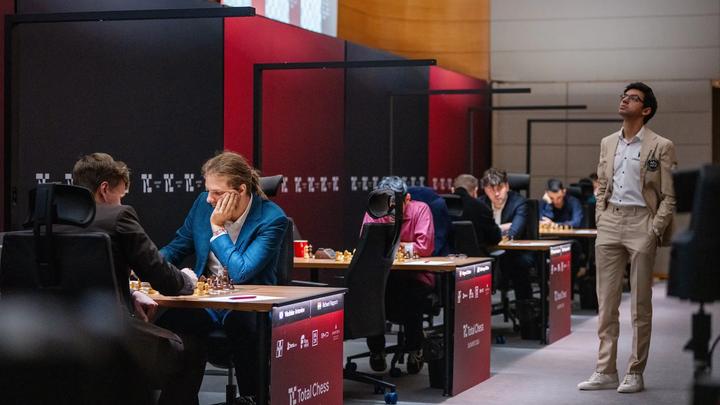
The inaugural Total Chess tournament ended in Budapest on Friday in uproar. GM Alireza Firouzja took the title, GM Anish Giri finished runner-up and the organisers were left facing some awkward questions about their experimental format.

That might have been the end of it. Except there were, as us Brits say, "afters".
That usually means a bit of a punch-up outside a pub after things have gone bad. In this case, we got the chess equivalent: the ethics complaint. FIDE launched disciplinary proceedings over Carlsen's refusal to play several scheduled games, and it accused the arbiters of failing to enforce the rules.
We're still a little stunned it turned out this way.
On Saturday, FIDE issued an extraordinary statement describing the world number one's conduct as "unacceptable" and announcing that the matter would be referred to its Ethics and Disciplinary Commission.
Signed by newly-minted FIDE President Timur Turlov and his Deputy President Viswanathan Anand, the statement also accused the tournament's arbiters of effectively abandoning their responsibilities and referred their conduct for examination.
I mean, wow. This was an event that FIDE itself had approved as a pilot for a new World Championship Tour and was effectively run by the people behind Norway Chess, one of the most progressive and professional outfits in the game. How could this go so wrong?
On Sunday, the opening ceremony of the classical World Championship takes place in Geneva, where reigning champ GM Gukesh D of India will defend his crown against Uzbekistan's hotshot GM Javokhir Sindarov.
The two 20-year-olds will contest the youngest match in World Championship history, with the first game scheduled for Tuesday, November 24. All our eyes should be focused on this. It doesn't get bigger - remember the months of anticipation last time? And the time before?
Yet the final days of the build-up have been dominated, at least within parts of the chess community, by wrangling about a different competition, a different world title and a player (yes, you, Magnus) who gave up his own classical crown four years ago.
Total Chess didn't end when the chess stopped
It is worth remembering what Total Chess was supposed to achieve.
Backed by Norway Chess and approved by FIDE, the new competition aims to establish a world championship that combines classical, rapid and blitz, rather than treating them as separate disciplines.
Norway Chess has raised an additional $10 million to develop the project, with investors including Manchester City footballer Erling Haaland and Norwegian skiing star Johannes Høsflot Klæbo. The full tour is scheduled to begin in 2027.
The commercial ambition is big and, while traditionalists may not approve (do they ever?) there is plenty of merit in the idea of a competition that rewards brilliance across different time controls. We get it.
And Budapest certainly delivered some exciting chess. Firouzja survived a dramatic Armageddon against GM Fabiano Caruana in the semifinals before beating Giri in another tiebreak to win the tournament.
But the unusual scoring system also produced some consequences that the organisers appear to have underestimated, and are now blowing up.
Each knockout day consisted of four blitz games worth one point each, two rapid games worth four points each and a Fast Classic game worth eight points.
That allowed players to secure their matches before the final game had even begun, leaving them with little incentive to play an encounter that could no longer affect the result.
Carlsen, he'll be the first to admit, exploited that situation by forfeiting games against GMs Bibisara Assaubayeva, while GMs Rapport and Abhimanyu Mishra also declined to play scheduled encounters.
The Norwegian then went further against the tricky GM Vladislav Artemiev, forfeiting two rapid games while their match was still undecided, before returning to win the Fast Classic game.
He subsequently skipped another Fast Classic encounter against Artemiev, although he won the Armageddon tiebreak to finish 17th.
Asked to explain his decisions after the tournament, Carlsen said he was exhausted and that he had wanted to choose which games to play.
"I wanted to play the games I wanted to play," he said.
FIDE was clearly unimpressed.
Its statement, which in itself was extraordinary, pointed out games forfeited after the result had already been decided and Carlsen's decision to skip three games against Artemiev while the outcome remained in doubt.
The federation said those actions threatened sporting fairness and showed insufficient respect for opponents, spectators and tournament partners.
It also acknowledged that the rules governing forfeits would need refining before 2027.
Before we go on, it's important to note the disciplinary referrals are not findings of guilt, and it remains to be seen what action, if any, will follow.
'What was this experiment for?'
Perhaps the most revealing comments came from Giri, who had just missed out on the title after losing the final to Firouzja.
Interviewed by IM Anna Rudolf, the always-erudite Dutch grandmaster questioned what the organisers had actually learned from the tournament.
"What was this experiment for?" he asked, in an official tournament interview. Good grief, they even posted it on YouTube.
Giri argued that the demands of the format should have been obvious before the event began. The long days, constant switching between time controls and dramatic swings caused by the weighted scoring system were all predictable consequences of the regulations.
He was also amused by the players who had decided not to turn up for some of their games.
"Apparently it is an option to not show up," he joked.
His remarks were not an attack on the entire concept. Giri said the tournament had given him confidence about competing with the world's best and that he expected to look back on Budapest positively once the disappointment of losing the final had faded.
But his broader point was difficult to dismiss.
Total Chess was supposed to test a format that would identify the strongest all-round player across three disciplines. Yet 20 of the 24 participants were eliminated from title contention during a group stage played entirely at Fast Classic, before rapid and blitz entered the knockout competition.
Carlsen, arguably the greatest rapid and blitz player in history, was among those eliminated.
There were other concerns, too, particularly over the decision to have the shortened Fast Classic games affect established classical ratings.
Carlsen came close to dropping below 2800 for the first time in 17 years, while Germany's Frankfurter Allgemeine Zeitung reported that Wesley So said almost all the players opposed the rating arrangements.
None of this means the experiment was a failure. But it does suggest that the regulations need more than a few cosmetic changes before the full tour begins.
Meanwhile, in Geneva...
While the fallout from Budapest continues, a rather different sort of chess competition is about to begin in Switzerland.
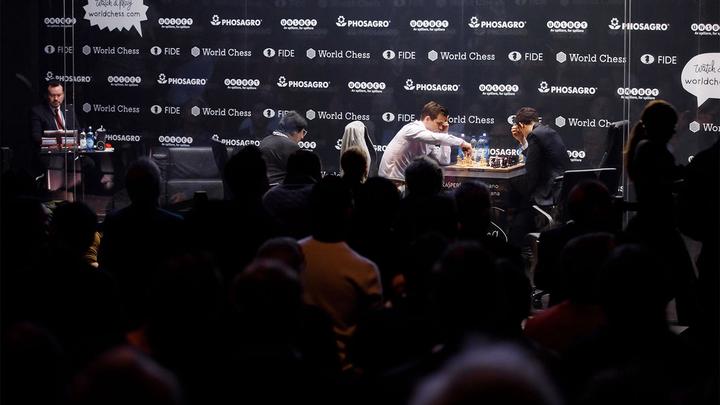
Gukesh and Sindarov will meet over 14 classical games at the Fondation Martin Bodmer in Cologny, overlooking Lake Geneva.
There will be no weighted blitz scores, no rapid games worth four times as much as a blitz victory and no opportunities to sacrifice entire sections of the competition in pursuit of a more valuable game later.
The players will sit opposite each other for several hours at a time, preparing deeply and trying to find an advantage against the same opponent over three weeks.
It is the format that has determined the classical world title for generations, although this particular match represents something entirely new.
Gukesh became the youngest undisputed World Champion in history when he defeated Ding Liren in Singapore in 2024, aged just 18.
Sindarov has since made a remarkable rise of his own, winning the 2025 World Cup and then the 2026 Candidates Tournament with an unbeaten 10/14 to become the first Uzbek player to challenge for the undisputed crown.
Both are just 20 years old. Their match is the youngest in the history of the World Championship, a contest that stretches back to Wilhelm Steinitz and Johannes Zukertort in 1886.
There is a rich story here about the changing geography of elite chess, India's remarkable production line of young grandmasters and Uzbekistan's emergence as a major chess power.
There is also the intriguing question of whether Sindarov can achieve what Carlsen, Ding and so many other challengers have done before him: take the title away from the reigning champion.
And unlike Total Chess, Geneva will produce the official classical World Champion.
FIDE has been careful to insist that the new Combined World Championship will not replace that traditional title. The intention is for the two competitions to coexist.
But their proximity on the calendar has created an unusual spectacle, with one World Championship still dealing with the consequences of its experiment as another prepares to begin.
Can chess have too many world champions?
The argument goes beyond the events of the past fortnight.
Chess already has separate classical, rapid and blitz world champions, alongside numerous other world titles and championship competitions.
Now Total Chess proposes to add a combined champion, with FIDE's blessing and substantial commercial backing.
The more titles the game creates, the more important it becomes to explain what each one represents.
The classical World Championship carries nearly 140 years of history, while Total Chess is trying to establish something different: a commercially attractive circuit that rewards players across multiple disciplines.
There is room for both, provided the distinctions are clear and the competitions are credible.
In fact, Budapest showed that the concept has potential. The knockout rounds delivered entertaining matches and unexpected comebacks, and the weighted scoring created situations rarely seen in traditional chess.
But the problems were real, too. Some players found themselves contesting games that could not change the outcome, while others chose to skip games that still mattered.
The rules governing ratings and the structure of the opening group stage also need scrutiny if Total Chess is to deliver on its promise of finding the strongest all-round player.
And FIDE's decision to refer Carlsen and the arbiters for disciplinary examination has ensured that the conversation will continue long after Firouzja collected his trophy.
For the moment, the federation has two very different tasks ahead of it: resolving the Budapest fallout and staging a World Championship in Geneva worthy of the history it represents.
It would be a shame if the former distracted too much from the latter.
Gukesh and Sindarov deserve their moment, and after all the arguments about whether players should have been obliged to play in Budapest, it will be refreshing to watch two young grandmasters who have spent months preparing for the opportunity to do precisely that.