Mr Dodgy Nearly Took Over FIDE. Eighty-Five Federations Thought That Was a Good Idea.
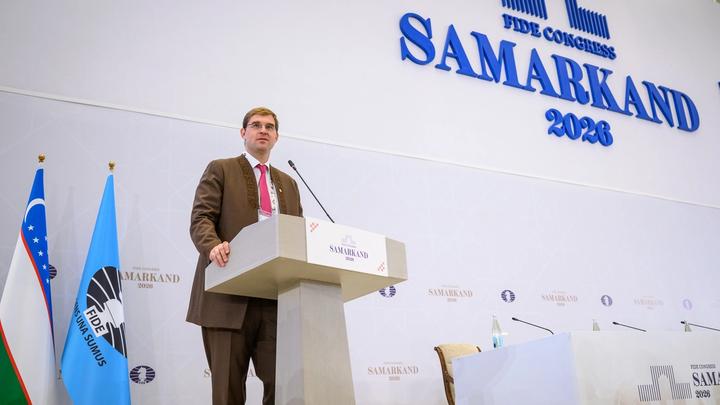
Timur Turlov won the FIDE presidency 110 to 85 in Samarkand. The 85 is the number worth worrying about, or celebrating, and I have not decided which.
I was in the room. Also the lobby, the pavilion, the Aloha party and the Latin Caribbean Night, which is to say I saw the whole thing, and I want to tell you what actually happened, because the result hides it.
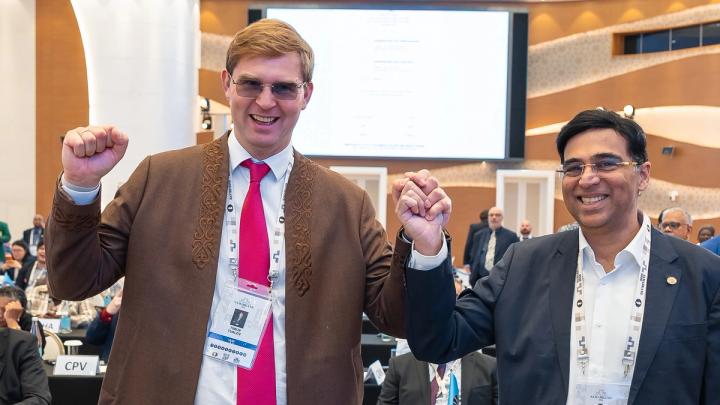
The official version is that a Kazakh banker beat a German logistics entrepreneur. That is true and useless. Turlov is a known quantity. He has run the Kazakhstan federation since 2023, he has been FIDE's principal commercial partner for four years, he has a Nasdaq ticker, a digital bank with twelve million customers, and Vishy Anand standing next to him. You can disagree with Turlov. You cannot be surprised by him. He is the most predictable thing to happen to FIDE since the invention of Fischer Random.
Wadim Rosenstein is the opposite, and this is where the story gets strange. Rosenstein arrived in chess in September 2022 with a chequebook and brand made up of his initials. He has never run a federation. His running mate, Gordon Tang, is a Singapore property man. And the people who actually ran his campaign, who filled the parties, worked the delegates and produced the general air that something new was happening, were not chess officials. They were chess people. Players, streamers, event organisers, the crowd that has spent a decade making chess fun online while FIDE was busy voting to abolish its own term limits. People like Mr Dodgy, a Scotsman living in Sweden, with 40,000 followers on X, whose signature achievement in the sport is a tournament where you are encouraged to play bad moves on purpose.
That man helped organise several of the campaign's events. At least he coordinated my participation in one. And 85 national federations, having watched all of this for two months, walked into a ballroom and voted for it.
Let me be precise about what they voted for, because it matters. Not for Rosenstein's programme, which existed in the sense that a website existed. Not for his availability, since he promised to be reachable 24/7 at the debate and then vanished from the broadcast four minutes later, and skipped the joint press conference in Samarkand without explanation. They voted for a mood. The mood was: the people who made chess popular should get to run it, and the people who have been running it should be asked to leave.
I have spent a decade of my professional life around FIDE. I have negotiated with it, sued it, been sued by it, and built a company on top of it. And I can tell you that the mood is not stupid. FIDE budgeted €8.35 million in corporate sponsorship over three years and collected substantially less. At the moment of writing, that is the FIDE business model. Nobody who came up through the commissions has ever built anything a normal person wanted to use. Mr Dodgy has, kind of. The streamers have. The kids who run the Discord servers have. If you asked me who understands the product better, a FIDE vice president or a man who has 40,000 people laughing at his openings, I would not need to think.
So would it have been good?
Here is the honest answer, which is also the uncomfortable one. I think that it would have been a catastrophe, and I would have enjoyed every day of it. FIDE is a treaty organisation with 200 members, a Swiss legal structure, a CAS docket, a Russian problem that ended up in Lausanne, and about €1.6 million in liquid funds sitting in Turlov's bank at year-end 2024. You cannot run that with an iPhone raffle. The Dodgy crowd knows what chess should look like. It has no idea what a general assembly is, what an ethics commission does, why the African confederation spent a morning deciding who was allowed to sign a letter backing Turlov, or why the man in the blazer saying he has "at least ninety votes" is always lying. They would have discovered all of it on the job, in public, on a stream, with lawyers.
And the sport would have survived, because the sport always survives FIDE. What would have died is the pretence that FIDE is an important organization and means something for the sport. There would probably be a second FIDE in a year or so.
Turlov did not win because his ideas were better. He won because he was legible. A bank, a budget, a fund of seven million dollars per year, a plan he had already been executing for two years as the "backstop." Delegates do not vote for the future. They vote for whoever can describe next Tuesday. I think that Rosenstein could not describe next Tuesday, and neither, I suspect, could anyone on his team, because they had never had to. That is not a character flaw. It is the difference between people who make things and people who administer them, and FIDE has been run by the second kind since 1924.
The unfair part is that the 85 will get blamed for the raffle and the Rolls-Royces and the Bentley bet, all of it, and none of that was the point. The point is that for the first time in the federation's history, a bloc of national federations looked at the apparatus and the internet and picked the internet. They lost by 25 votes. Four years ago the reform candidate got 16.
They will be back in 2030. If they do, then Mr Dodgy will know what a commission is, and Timur Turlov will have had four years to prove that boring works (or it doesn’t have to be boring), and I will have to decide whether I was rooting for the wrong side.
By Ilya Merenzon, CEO of World Chess